
Content Writing vs Copywriting: Which Does Your New Zealand Business Need in 2026?
3 November 2026 · By Top SEO Specialists
Content writing educates and builds trust over time. Copywriting persuades and drives one specific action right now. Neither is better in general. The right choice depends on the asset: hire a content writer for the pages that earn traffic and authority, and a copywriter for the pages that turn that traffic into revenue. Most New Zealand businesses end up needing both, deployed at different stages of the funnel.
Key Takeaways
✓ Content writing teaches. Copywriting sells. The job of the page decides which one it is, not its length or where it appears.
✓ Content is measured by traffic, engagement, and authority built over months. Copy is measured by conversion rate, often within days.
✓ Copywriting pays more because it is tied directly to revenue. International benchmarks put experienced copywriters well above content-writing rates, and low-end content work is being squeezed by AI.
✓ The most expensive mistake is hiring the wrong writer for the asset: a beautiful sales page that converts at 0.3%, or a blog that ranks for nothing.
✓ AI is widening the gap between the two crafts, not closing it. Commodity content is getting cheaper; proven direct-response copy is getting more valuable.
✓ You need content before you need copy. Traffic has to exist before there is anything to convert.
What is content writing?
Content writing is writing that informs, educates, or entertains. Blog posts, guides, case studies, newsletters, ebooks, video scripts, and help documentation all fall under it. The reader should feel smarter after reading, not sold to. As YouTuber Luke Morgan puts it in his much-watched explainer, reading good content feels like “engaging in a conversation with a friend.”
The goal is long term: attract the right audience, answer their questions better than anyone else, build authority, and earn a place in search results. Content writers think in terms of depth and completeness. What does the reader need to fully understand this topic? What will they ask next? How do we make this the most useful resource on the subject? That mindset is why SEO and content writing are natural partners: ranking well in competitive search results requires genuine depth, and our SEO services treat content as the engine of organic growth, not an afterthought.
Content is judged slowly. A good article compounds over months as search traffic builds, links accumulate, and readers return. A piece of copy is typically used for a few months, while a strong piece of content can keep working for years.
What is copywriting?
Copywriting is writing designed to make the reader do one specific thing: buy, book, sign up, click, call. Landing pages, sales pages, product descriptions, ads, email sequences, headlines, taglines, and calls to action are copy. Every word earns its place by removing resistance and moving the reader forward.
The goal is immediate and measurable. A headline change can lift conversion rates by 20 to 30 percent, and a well-placed call to action can boost them by 40 to 50 percent, per standard direct-response benchmarks cited in practitioner courses. That is why copy is judged in days, not months: did the reader do the thing.
Copywriters think in terms of psychology and friction. What does the reader believe right now? What objection stops them? What single action matters on this page? Copywriting strategist Rob Palmer frames it with an analogy worth remembering: “You would not hire an architect to do a structural engineer’s job just because they both work with buildings. Content writers and copywriters both work with words, but the engineering underneath is completely different.”
Content writing vs copywriting: the head-to-head comparison
| Content writing | Copywriting | |
|---|---|---|
| Primary goal | Educate, inform, build trust | Persuade, drive one action now |
| Reader’s stage | Researching, learning, comparing | Ready or nearly ready to decide |
| Typical formats | Blog posts, guides, case studies, newsletters, ebooks | Landing pages, sales pages, ads, emails, product pages |
| Length | Usually long-form, as long as the topic needs | Usually short-form, as short as conversion allows |
| Tone | Informative, conversational, evidence-led | Direct, benefit-led, urgency where honest |
| Call to action | Soft or none; the value is the point | Explicit; the action is the point |
| Role of SEO | Central: most content is found through search | Secondary on ads and emails; central on landing pages |
| Success metric | Organic traffic, engagement, shares, assisted conversions | Conversion rate, revenue per visitor |
| Time to results | Months; compounds over time | Days; judged almost immediately |
| Lifespan | Years | Months, then it is refreshed or replaced |
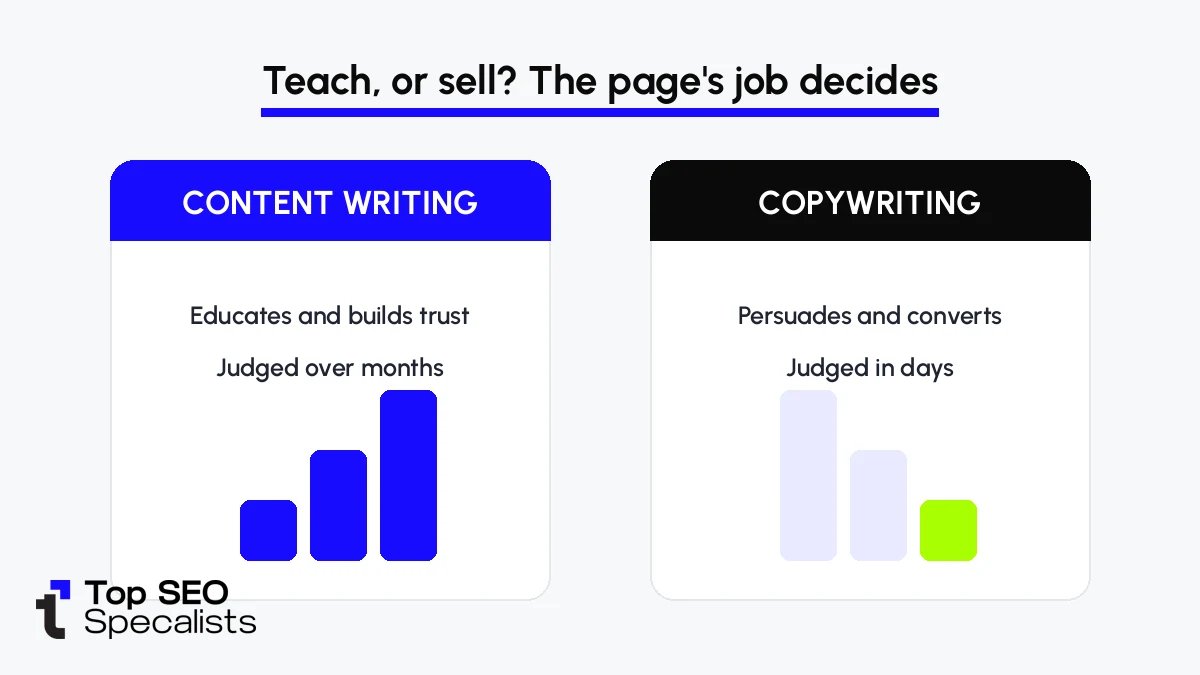
Teach, or sell? The page’s job decides.
The test that settles it: what is the page's job?
Here is the distinction most comparison pages miss. The page’s goal, not its length or channel, decides whether it is content or copy.
A 3,000-word sales page is copy, because its job is to convert. A 150-word product description is copy for the same reason. A long, detailed guide with no ask is content. An email that teaches is content; an email that sells is copy. As one practitioner puts it, if it teaches and sells, in most cases it is still copywriting, because the selling intent is what defines it.
This test is the practical tool for the rest of this article. Before you hire anyone or brief anything, write down the page’s one job. If the job is “make them understand”, you need a content writer. If the job is “make them act”, you need a copywriter. Everything that follows is just that test applied to real business situations.
When should you hire a content writer?
Hire a content writer when the asset’s job is to attract, educate, and build authority:
✓ You need organic traffic. Blog posts, guides, and resources that rank on Google and bring in a steady stream of potential customers. This is the core of our content writing service.
✓ Your buyers research before they buy. Professional services, B2B, healthcare, renovations. People read several pages before they enquire, and they buy from whoever taught them most.
✓ You want to be found for questions, not just keywords. How-to content, comparisons, and explainers capture the informational searches your competitors ignore.
✓ You are building topical authority. A cluster of genuinely useful articles tells Google, and readers, that you are the authority in your space. AI Overviews cite the same well-structured expert pages that rank organically.
✓ Your sales cycle is long. The longer the gap between first visit and purchase, the more education has to happen in between. Content fills that gap.
✓ You need a newsletter people actually open. Teaching beats pitching in the inbox, week after week.
When should you hire a copywriter?
Hire a copywriter when the asset’s job is to convert attention you already have:
✓ Your landing pages do not convert. Traffic arrives and leaves. A copywriter rebuilds the page around one action: the headline, the offer, the proof, the call to action.
✓ You are running ads. Every click costs money, so the page it lands on has to convert. Paid traffic with weak copy is the fastest way to burn a budget.
✓ You are launching something. A new service, a new offer, a seasonal push. Launches live or die on persuasion, not information.
✓ Your emails do not get replies. Nurture sequences, abandoned-cart emails, reactivation campaigns. Copywriters write emails that get opened and acted on.
✓ Your homepage reads like a brochure. Most homepages describe the business. A copywriter rewrites it around the visitor: what they get, why it matters, what to do next.
✓ Pricing and product pages underperform. These are the closest pages to revenue on your site. They deserve the highest-paid words you will ever buy.
When you need both: the full-funnel relay
The highest-performing businesses do not choose between the two. They sequence them. Content earns the traffic; copy converts it. A content writer publishes the guide that ranks on Google, and a copywriter writes the call to action and the follow-up emails that turn readers into customers.
Handled this way, the two crafts stop competing and start compounding. The content lowers your cost of attention. The copy raises the value of every visitor. Most New Zealand businesses we work with need the content layer first, because traffic has to exist before there is anything to convert, and then the copy layer on the pages closest to revenue.
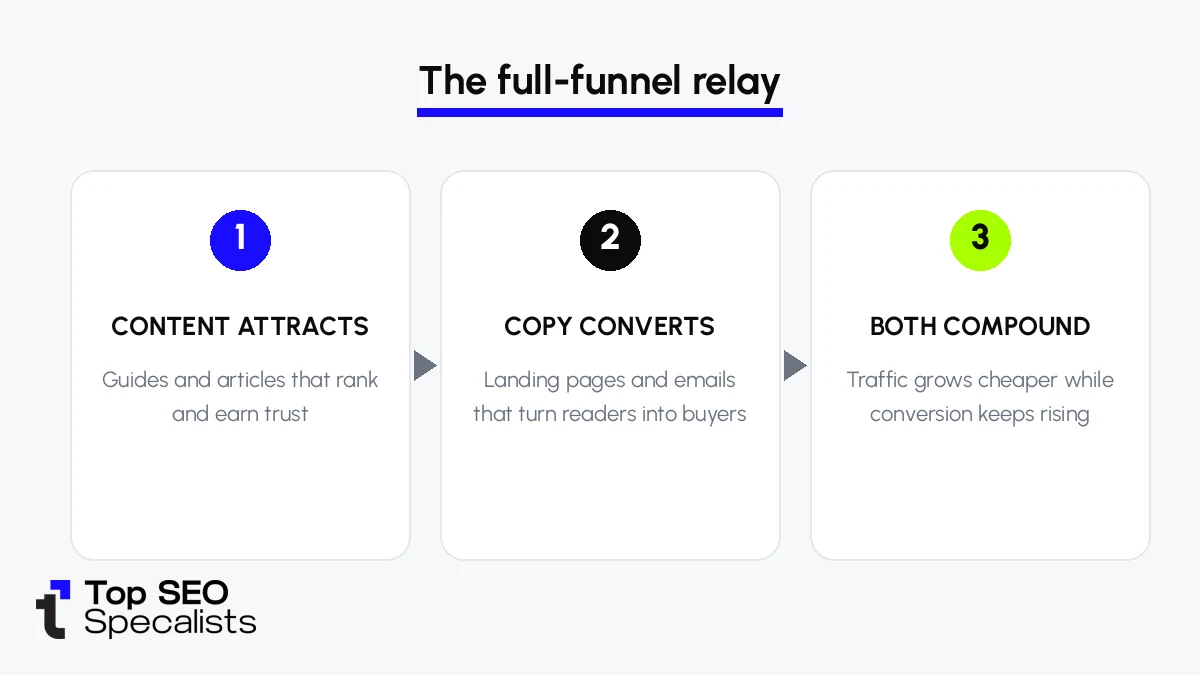
Content attracts, copy converts, both compound.
What do content writers and copywriters charge?
An honest note first: verified New Zealand-specific writer rate data is thin, so we will not invent NZ figures. The benchmarks below are international, attributed, and directional. Treat USD figures as quoted by the source, and remember all of them exclude GST.
Copywriting pays more, and the reason is structural. Copy is tied directly to revenue, so clients pay for outcomes. Content is tied to traffic and trust, which are harder to price. A 2026 freelance industry guide reports average copywriter salaries around US$62,170 per year, hourly rates averaging US$36.74 with top earners above US$67, and brand messaging projects at US$1,000 to US$5,000 or more. Expert sales-page copywriters command US$10,000 or more per project. One working professional reports retainer arrangements with established brands running US$8,000 to US$20,000 per month, noting these reflect trackable revenue, not inflated egos.
Content writing rates spread wider and sit lower. Beginners earn US$15 to US$30 per hour or US$50 to US$200 per article in the early stages. At the bottom end, content jobs at US$0.05 a word are common, and the advice from working copywriters is blunt: stay away from them. The US Bureau of Labor Statistics puts the median writer’s wage at US$76,910 as of May 2025, a figure that covers both crafts and every skill level.
Two things follow for a New Zealand business. First, if a quote looks impossibly cheap, you are buying the bottom of that range: thin, interchangeable words that neither rank nor convert. Second, judge the quote against the asset’s job. Expensive copy on a page that converts is cheap. Cheap content that ranks for nothing is expensive.
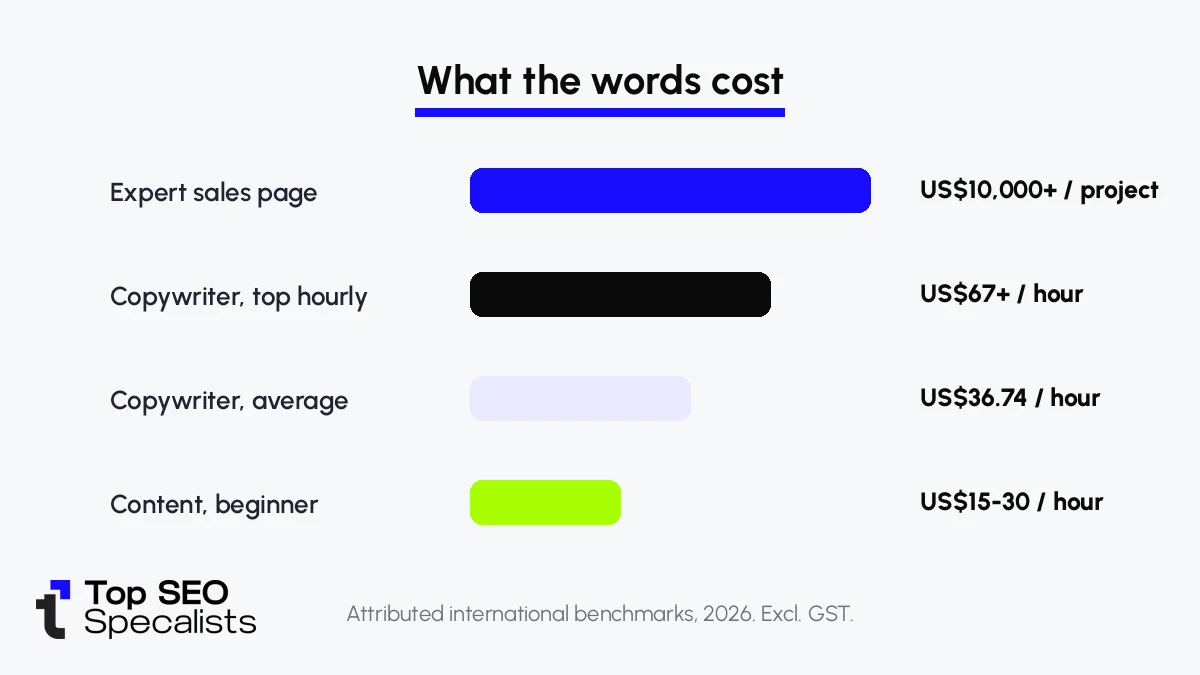
What the words cost: attributed international benchmarks, 2026. Excl. GST.
The expensive mistake: hiring the wrong writer
This is the section that costs real businesses real money. The single biggest mistake, in the words of a practitioner with a decade in both disciplines, is “hiring the wrong type of writer for the job they need done.”
The story repeats every month. A business needs a sales page, a video sales letter script, or an email sequence to turn traffic into revenue. They post a job for a “writer”. Fifty applications arrive, almost all from content writers, because content writers outnumber copywriters roughly ten to one. They hire a good one. The page is beautifully written. And it converts at 0.3 percent.
They did not hire a bad writer. They hired the wrong type of writer. The failure runs the other way too: a copywriter hired to build an SEO content engine produces punchy pages that never rank, because ranking was never their craft. Either way the business concludes that “writing doesn’t work”, when the writing was never the problem. The brief was.
The cheapest protection is the test from earlier in this article. Write down the asset’s one job before you post the job ad. Then hire the specialist whose craft matches it, and check their portfolio for that exact type of asset, not just “good writing” in general. If you want the same discipline applied to SEO hiring, our guide to what to ask before hiring an SEO provider runs through the seven vetting questions.
Can one person do both well?
Honestly, sometimes, but it is rarer than job ads pretend. The crafts pull in opposite directions: depth and completeness versus brevity and pressure; teaching versus closing. As one professional puts it, asking for a “content writer who can also do copywriting” is like asking for a surgeon who can also do stand-up comedy. Both involve performance under pressure, but the skill sets are fundamentally different.
What to do instead: if you need both crafts and one hire, look for a writer whose portfolio proves both, with conversion numbers on the copy side and ranking or traffic numbers on the content side. Failing that, hire the craft you need most urgently and contract the other per project. A hybrid who is genuinely excellent at both charges accordingly, which brings us back to the pricing section above.
How AI changed the maths in 2026
AI did not blur the two crafts. It pulled them further apart. Commodity content, the US$0.05-a-word kind, is exactly what AI produces well, so low-end content writing fees are being compressed hard. Direct-response copywriting, where every word has to move a specific human to a specific action, is much harder to automate, and the premium on proven copywriters is rising.
The implication for hiring is straightforward. Do not pay human rates for words AI could draft; use AI for first drafts and research assistance, then pay humans for judgment, voice, and persuasion. And be deeply suspicious of any provider whose entire process could be replaced by a prompt. If their work is indistinguishable from AI output, their pricing should be too.
Frequently asked questions
Content writing informs, educates, or entertains to build trust and authority over time. Copywriting persuades the reader to take one specific action, like buying or signing up, right now. The page’s goal decides which one it is, not its length.
Neither is better in general. Content writing is better when you need traffic, authority, and long-term trust. Copywriting is better when you have attention and need it to convert into revenue. Most businesses need both, sequenced to match their funnel.
Yes, on average. Copywriting is tied directly to revenue, so clients pay for outcomes. International benchmarks put experienced copywriters well above content-writing rates, while low-end content work faces the most pressure from AI. The gap reflects measurability, not talent.
Some can, but excelling at both is genuinely rare because the crafts pull in opposite directions: depth and teaching versus brevity and closing. If you need both from one hire, demand proof of both in their portfolio, with conversion numbers on the copy side and traffic or ranking numbers on the content side.
Hire a copywriter when the asset’s job is conversion: landing pages, sales pages, ads, email sequences, pricing pages. Hire a content writer when the job is traffic and trust: blog posts, guides, resources, newsletters. Write down the asset’s one job before you post the ad.
Sometimes, but it is not the point. SEO is central to content writing because most content is found through search. For copy, SEO matters on landing and product pages but is secondary on ads and emails, where persuasion is everything.
Brief a content writer with the question the reader is asking, the search intent, and what the most useful resource on the topic looks like. Brief a copywriter with the single action the page must drive, the reader’s objections, and the offer. One brief teaches, the other closes.
AI is replacing commodity writing, not skilled writing. Low-end, interchangeable content is being automated and its fees compressed. Persuasive copy tied to real customer psychology, and expert content with genuine depth, are getting more valuable, not less. Hire for judgment, not word count.
What to do next
If you are planning content right now, run the test from this article over every page on your list. Write down each asset’s one job. The ones that teach go to a content writer. The ones that close go to a copywriter. And if your list is mostly “we need a blog”, start with our content writing service: SEO-driven articles built to rank, with the strategy behind them. If your traffic is fine but nothing converts, that is a copy problem on your money pages, and our SEO services start with a technical audit that shows exactly where visitors drop off. For local businesses, our local SEO service covers the Google Business Profile work that turns “near me” searches into calls.
Or skip the guesswork and get the audit first: a free, no-obligation look at where you stand, what is broken, and which craft your business needs first. Get a free audit.
Not sure which writer your business needs? Start with the audit.
We will look at your pages, tell you which assets should teach and which should close, and show you where you stand before you spend anything.
Keep reading
The same hiring discipline, applied to SEO providers.
Content earns the traffic; the funnel decides the rest.
SEO-driven articles built to rank.