
SEO Expert vs SEO Specialist vs SEO Agency: What Should a New Zealand Business Hire in 2026?
30 October 2026 · By Top SEO Specialists
An SEO specialist is a hands-on practitioner who does the day-to-day work of ranking websites. “SEO expert” is an unregulated label anyone can claim, so it tells you nothing by itself. An SEO agency is a team selling SEO as a service. For a New Zealand business, the title on the business card matters far less than proof: real case studies, revenue tied to the work, and direct access to your own accounts.
Key Takeaways
✓ “SEO expert” is not a protected title. Anyone can call themselves one, which is exactly why you should never hire on the title alone.
✓ An SEO specialist is the practitioner role: keyword research, on-page and technical SEO, content, link building, and reporting.
✓ An agency gives you a team and process; a freelancer or solo expert gives you one person’s full attention, usually at a lower cost.
✓ In New Zealand, effective SEO retainers typically run NZD $1,500 to $5,000 per month; anyone promising page one for a few hundred dollars is selling you something else.
✓ Vet every provider the same way: ask for case studies with revenue attached, ask who actually does the work, and demand admin access to your own accounts from day one.
✓ A guarantee of rankings is not confidence. It is the single biggest red flag in this industry.
What does an SEO expert actually do?
Start with the uncomfortable truth, because every honest practitioner on the forums says the same thing: “SEO expert” is a self-awarded title. There is no exam, no licence, no governing body. As one much-quoted Quora consensus puts it, if someone is well known in SEO they get called an expert or a specialist interchangeably. The title is earned through reputation, not granted by anyone.
So what does a person calling themselves an SEO expert actually do, day to day? The same core work as any good SEO practitioner: researching the keywords your customers actually type and the intent behind them; auditing your site for technical problems that block rankings; fixing on-page elements like titles, headings, content structure and internal linking; planning and guiding content that deserves to rank; building links and digital PR that earn authority; and tracking everything in Google Analytics and Search Console, reported in plain language.
Google’s own AI Overview, summarising ZipRecruiter, draws the line this way: a specialist is the hands-on practitioner implementing day-to-day tactics, while “SEO expert” is a broad, informal label for anyone with advanced, high-level mastery. In practice, when a New Zealand business hires an “SEO expert”, they are usually hiring a solo consultant or freelancer selling senior-level judgment rather than a pair of hands.
That distinction matters for what you pay and what you get, which we will come to. But first, the honest reframe: stop shopping for the title. Shop for the proof.
What does an SEO specialist do?
The specialist is the clearer of the two labels. It describes a practitioner role, and the job description is remarkably consistent everywhere from agency glossaries to YouTube career guides: keyword research and search intent analysis; technical SEO audits and fixes; on-page optimisation; content planning and optimisation; link building and outreach; local SEO, including Google Business Profile work; and measurement and reporting.
YouTuber Nathan Gotch, whose SEO career videos have millions of views, calls it “the art and science” of SEO and is blunt about the job’s purpose: raise keyword rankings to win organic traffic, which becomes leads, customers, and sales. That is the only definition that matters to a business owner. Everything else is process.
A specialist typically works in one of three setups: inside an agency (doing the work for many clients), in-house at one company, or freelance. The title tells you their function. It does not tell you their seniority. A junior with six months of experience and a veteran of ten years can hold the same job title, which is why the forums keep repeating the same advice: judge the person, not the label.
What does an SEO agency do?
An agency sells you a team and a process instead of one person. In theory you get strategists, technical specialists, content writers, and link builders under one roof, plus account management and reporting systems. For a busy business owner who does not want to manage SEO at all, that done-for-you model is the appeal.
In practice, as one BlackHatWorld commenter put it, “agencies are still a bunch of individuals under one roof.” The quality of your campaign comes down to which individuals touch your account, not the agency’s logo. That is also where agency horror stories begin: the salesperson who pitched you is not the junior who does the work, and you may never meet the junior at all. StudioHawk, an Australian agency, uses as a selling point that clients get “direct access to SEO specialists, no sales or account managers in between”, which tells you how common the complaint is.
None of this means agencies are bad. It means an agency has to be vetted on the same grounds as an individual: who does the work, what have they achieved, and what do you actually get each month.
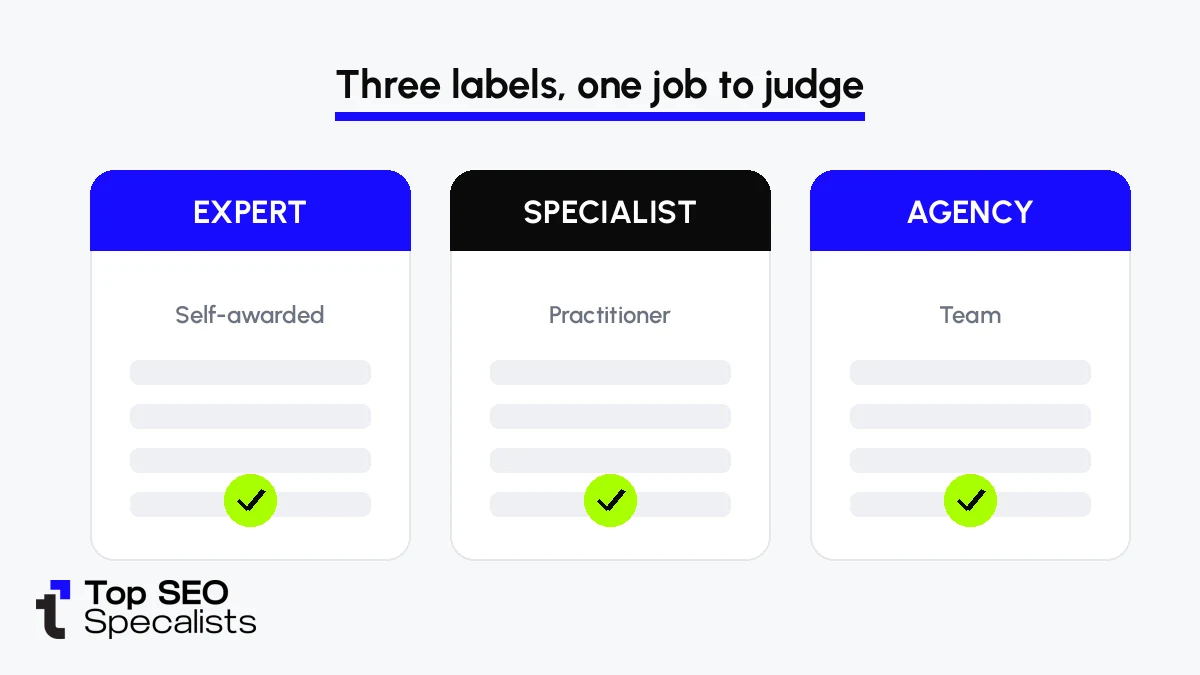
Three labels, one thing to judge: proof of results.
SEO expert vs SEO specialist vs SEO agency: the real difference
Here is the comparison nobody on page one of Google actually makes, because every ranked page treats the titles as interchangeable:
| SEO expert (label) | SEO specialist (role) | SEO agency | |
|---|---|---|---|
| What it means | Informal claim of advanced mastery; unregulated | Practitioner job title; describes function | A business selling SEO as a service |
| Typical setup | Solo consultant or freelancer | Agency team member, in-house, or freelance | Team: strategists, technicals, writers, link builders |
| What they sell | Senior judgment, strategy, audits | Hands-on execution across the SEO task list | A managed process and continuity |
| How to judge them | Case studies, revenue impact, references. The same test for all three. | ||
| The risk | The title alone proves nothing | Junior and veteran share the same title | You may never meet who does the work |
The real difference that matters to your wallet is not expert versus specialist. It is freelancer versus agency versus in-house. That is a business-model choice with different costs, different accountability, and different failure modes.
Freelancer vs agency vs in-house: which model fits your business?
Hire a freelancer or solo expert when
You have a defined problem (a technical audit, a site migration, local rankings in one city), you want senior attention on your account, and your budget is modest. You get one person’s full focus, direct communication, and lower overhead. The risk is capacity: one person gets sick, goes on holiday, or takes on too many clients, and your campaign stalls.
Hire an agency when
You want SEO fully handled without managing it, you need multiple skill sets at once (technical, content, links, reporting), or you are spending enough to justify a team. You get process, coverage, and continuity. The risks are the ones the forums document in painful detail: paying for months with nothing to show, vanity-metric reports instead of revenue, lock-in contracts, and never knowing who actually does the work. One r/smallbusiness owner described spending over $6,200 with a vendor that controlled the website and tracking number and produced zero legitimate leads. An Australian agency published a client’s words verbatim: “We tried an SEO agency for 12 months. Spent about $20,000. Got nothing.”
Hire in-house when
SEO is central to how you get customers, you have continuous content and technical needs, and you can keep one good person busy full time. You get total alignment and instant communication. The risk is the single point of failure: one person’s knowledge ceiling becomes your ceiling, and good in-house SEO people are hard to find in the NZ market.
A practical rule from the practitioner threads: match the model to the job, not the title. A Hamilton plumber needing map-pack rankings does not need an agency. A national e-commerce brand does not need a solo freelancer working Fridays.
How much does each option cost in New Zealand?
Let us talk money with real numbers, because vague pricing is where bad decisions start.
For agency SEO in New Zealand, our own service page publishes the honest range: effective SEO here typically costs between NZD $1,500 and $5,000 per month depending on market competitiveness and goals. Our published plans start at $1,000 per month. Anyone quoting a few hundred dollars a month for “full SEO” is either doing almost nothing or doing things that will get you penalised.
For freelancers, there is less published NZ data, so here are attributed benchmarks rather than guesses. On BlackHatWorld, UK freelancers report charging £40 to £60 per hour against agency day rates of £800 to £1,000, and one thread puts average local freelancer retainers around $467 per month in their market. Treat those as directional, not as NZ quotes. The NZ reality: a competent NZ-based freelancer will usually cost less per month than an agency retainer but more per hour of actual senior time, because you are buying all senior hours and no account-management overhead.
For in-house, you are looking at a full NZ salary plus the tools (Ahrefs or Semrush, a crawler, a rank tracker) on top. Verified NZ-specific SEO salary data is thin on the ground, so we will not invent a figure. What we can say: if you cannot keep someone busy on SEO-adjacent work for 30-plus hours a week, in-house is the most expensive option per unit of output.
One figure from the practitioner threads is worth memorising: $500 a month will not buy you an expert anywhere. If the budget is tiny, spend it on a one-off technical audit from someone good, fix what it finds, and revisit retainers when you can afford real work.
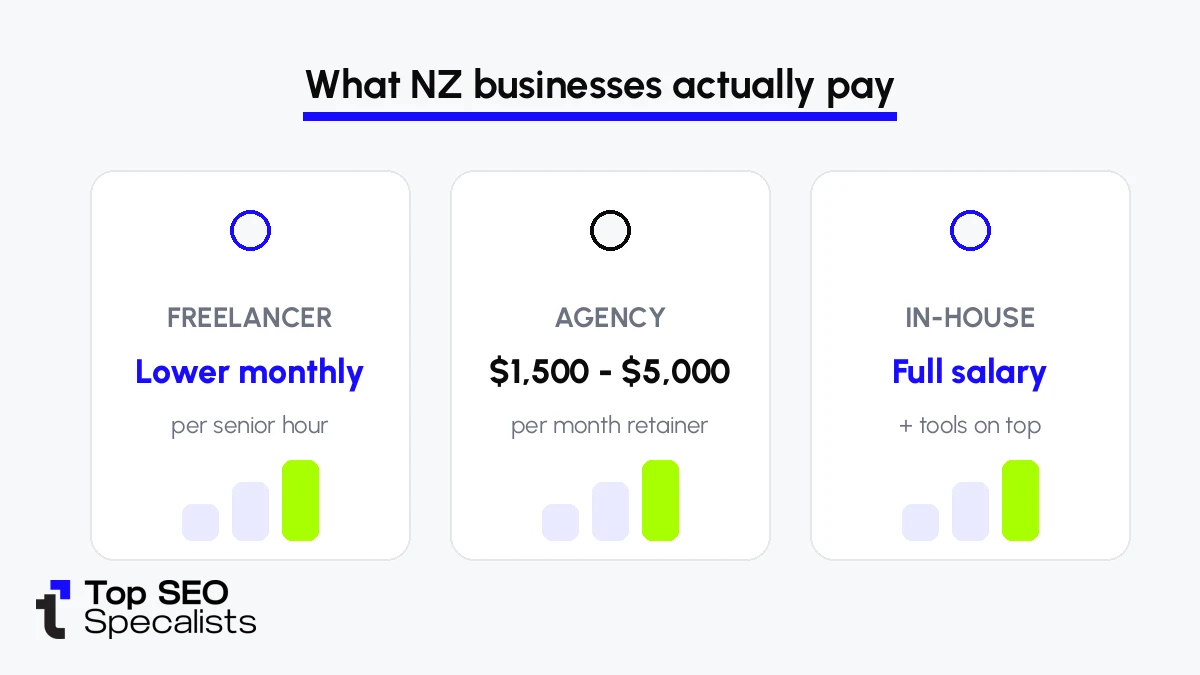
What NZ businesses actually pay: agency retainers, freelancer benchmarks, and in-house cost.
How to vet any SEO provider: 7 questions to ask
This checklist is distilled from a January 2026 r/SEO practitioner thread on telling a real specialist from a phoney, plus a decade of forum wisdom. Ask every candidate, freelancer or agency, the same seven questions:
1. Show me case studies with revenue attached
Not rankings screenshots, not traffic graphs. Pages improved, rankings gained, and money in the till, ideally visible in GA4. “SEO isn’t snake oil. Good pages get business results.”
2. Who exactly does the work on my account?
If it is not the person pitching you, you want to meet the person doing it and see their track record.
3. Show me your process for a technical audit
Then ask one genuinely technical question, about hreflang, schema markup, or how they handle AI Overviews. A practitioner answers precisely. A salesperson deflects.
4. What is the 30, 60, and 90-day plan?
Vague promises of “research and optimisation” are not a plan. You want named deliverables with dates.
5. How do you build links, exactly?
You are listening for real outreach and digital PR. Evasion here is disqualifying.
6. Do I keep admin access to everything from day one?
Google Business Profile, Analytics, Search Console, ad accounts, the website itself. A provider who wants to own your assets is planning for the breakup, not the marriage.
7. Do you guarantee rankings?
The only acceptable answer is no. No honest operator guarantees specific rankings, and Google says the same. Ask question seven first if you are short on time. It filters out half the market in ten seconds.
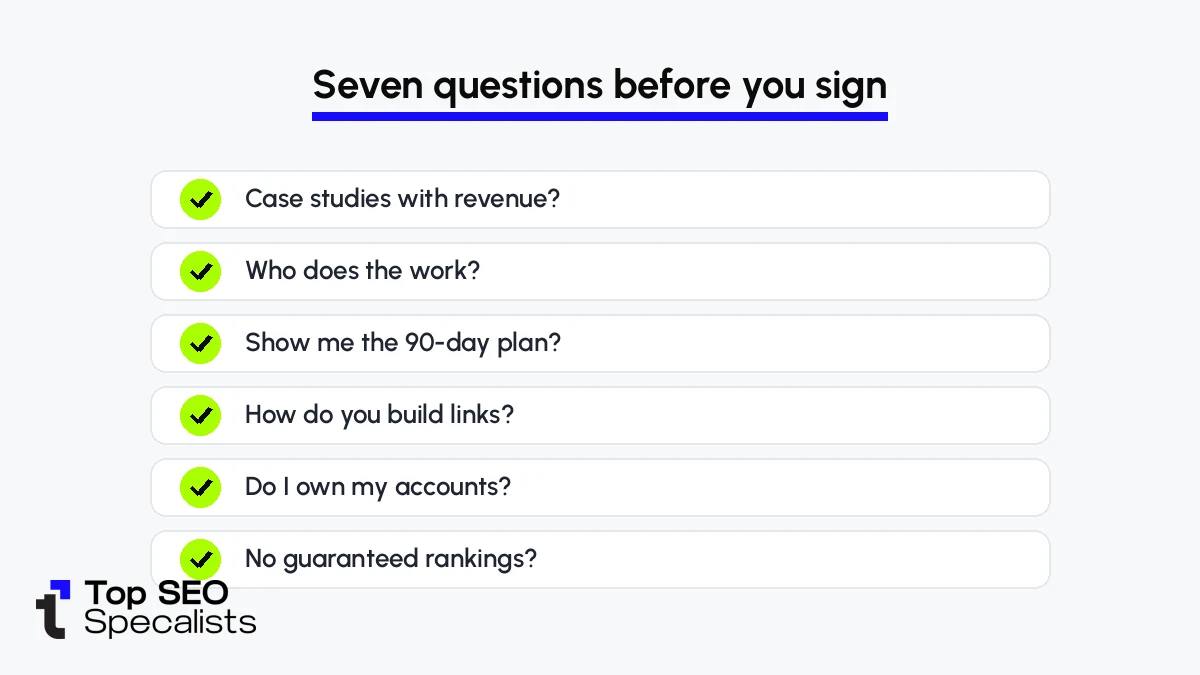
Seven questions before you sign anything.
Red flags that mean walk away
• Guaranteed rankings or guaranteed page one.
• No case studies, or case studies with no business results.
• Reports full of vanity metrics: rankings for keywords nobody searches, traffic that never converts.
• You cannot find the provider ranking for anything themselves. As one Redditor put it: “If they can’t rank their own site, how will they rank yours?”
• Lock-in contracts with no performance exit.
• The pitch focuses on deliverable counts (X links, Y blog posts) instead of outcomes.
• Toxic shortcuts in the backlink profile: one r/startups founder described a $400-a-month agency building casino and pharma links that earned a manual penalty and a nine-month recovery.
• Ghosting, rotating account managers, or reports that arrive late and unexplained.
• Pressure tactics, “special pricing expires today”, or refusal to put quantities in writing.
Is SEO dead now with AI? Should I still hire?
This was one of the most asked questions in the research, so here is the short answer: no, and yes. Google still holds over 90% of traditional search, and AI Overviews reward exactly what good SEO has always produced: well-structured, genuinely expert content. What AI killed is thin, interchangeable content, which never worked for long anyway.
The hiring implication is real, though. Ask candidates how they optimise for AI Overviews and answer engines, not just blue links. A provider with no answer is optimising for 2019.
Frequently asked questions
What to do next
If you are comparing providers right now, run every candidate through the seven vetting questions above before you sign anything. And if you want a second opinion on your current situation, start with our SEO services: every engagement begins with a technical audit, published pricing, and month-to-month terms. For businesses competing locally, our local SEO service covers the Google Business Profile and map-pack work most agencies gloss over. If content is your bottleneck, that is a hiring criterion in itself: ask who writes, and read our content writing service page to see what a real content process looks like.
Or skip the sales calls entirely and get the audit first: a free, no-obligation look at where you stand, what is broken, and what it would take to fix. Get a free audit.
Hiring SEO help? Start with the audit, not the sales call.
We will show you where you stand, what is broken, and what it would take to fix, before you spend a dollar.
Keep reading
The local foundation every NZ business needs.
Map-pack work most agencies gloss over.
Real results with real numbers.