
How Long Does Local SEO Take in New Zealand? The Honest 2026 Timeline
5 November 2026 · By Top SEO Specialists
For most New Zealand businesses, Google Maps visibility can start moving within weeks of fixing your Google Business Profile, meaningful website rankings usually take 3 to 6 months, and steady enquiries from search tend to take 6 to 12 months. A new website, a competitive Auckland market, or a crowded trade can push that to 12 months or longer. Those are planning ranges, not promises, and no one can guarantee you a ranking by a date.
Key Takeaways
✓ Local SEO has two clocks. Your Google Business Profile and the Map Pack can move in weeks. Website rankings take months.
✓ For most NZ businesses, plan on 3 to 6 months for meaningful improvement and 6 to 12 months for steady enquiries. New sites and competitive Auckland markets take longer.
✓ The first signs are quiet and live inside Google’s own tools: indexed pages, Search Console impressions, then Business Profile views and actions, then rankings, then calls.
✓ By month four you should have proof of work, a baseline, indexed key pages, and two complete months of data to compare.
✓ No NZ-wide study of local SEO timing exists. The ranges in this guide come from NZ agency guidance and one published NZ case.
How long does local SEO take? The short answer
You started paying for local SEO a few months ago, or you started doing it yourself on weekends, and the phone sounds about the same as it did before. The invoices arrive on time. The reports, if you get any, are full of charts you cannot tie to a single customer. So you ask the question every New Zealand business owner asks sooner or later: how long does local SEO take?
Most practitioners give the same range. An Ahrefs poll of 3,680 SEO practitioners found the most common answer was 3 to 6 months for meaningful results. New Zealand agencies say much the same: EightySix Digital puts early signs at 1 to 3 months and meaningful improvements at 3 to 6 months, with new websites and competitive Auckland markets at 6 to 12 months or longer.
Google itself is vaguer, and it recently became vaguer still. Its guide to hiring an SEO used to say results typically take four months to a year from the time you begin making changes until you start to see the benefits. That line came from a 2017 video featuring Google’s Maile Ohye. It was still in the archived copy of the page on 20 May 2026, and it was gone from the next copy in June 2026. What Google says now is that some changes might take effect in a few hours and others could take several months.
None of that is a promise. It is a description of how the system works: Google has to find a page, crawl it, index it, and then weigh it against other pages before it shows up for anyone. That takes time, and the time depends on where you start and who you are up against.
Local SEO runs on two clocks, not one
The single biggest reason business owners get confused about the timeline is that local SEO is two jobs running at different speeds.
Clock one is the Map Pack clock. This is your Google Business Profile, the map, and the three business listings that appear above the website results for local searches. Google reads profile changes quickly. Fixing your primary category, completing your services, correcting your hours, adding real photos, and starting a steady flow of genuine reviews can lift your Maps visibility within weeks.
Clock two is the website clock. This is your website ranking in the ordinary organic results below the map. It moves slower because it depends on crawling, indexing, content, and authority building up over time. Website rankings usually build over 3 to 6 months, and steady enquiries take 6 to 12 months.
| Map Pack clock | Website clock | |
|---|---|---|
| Main asset | Google Business Profile | Your website pages |
| What moves it | Relevance, distance, prominence | Relevance, quality, authority, technical health |
| First movement | Weeks, after profile fixes | 1 to 3 months, impressions first |
| Meaningful results | 1 to 3 months for low-competition searches | 3 to 6 months |
| Steady enquiries | 3 to 6 months | 6 to 12 months |
| What to watch | Map visibility, profile views, calls, direction requests | Impressions, query coverage, rankings, clicks |
Our Google Maps SEO guide explains the Map Pack side in detail, including the two-minute test you can run on your own profile today. The rest of this article covers both clocks together, because a real campaign works on both at once.
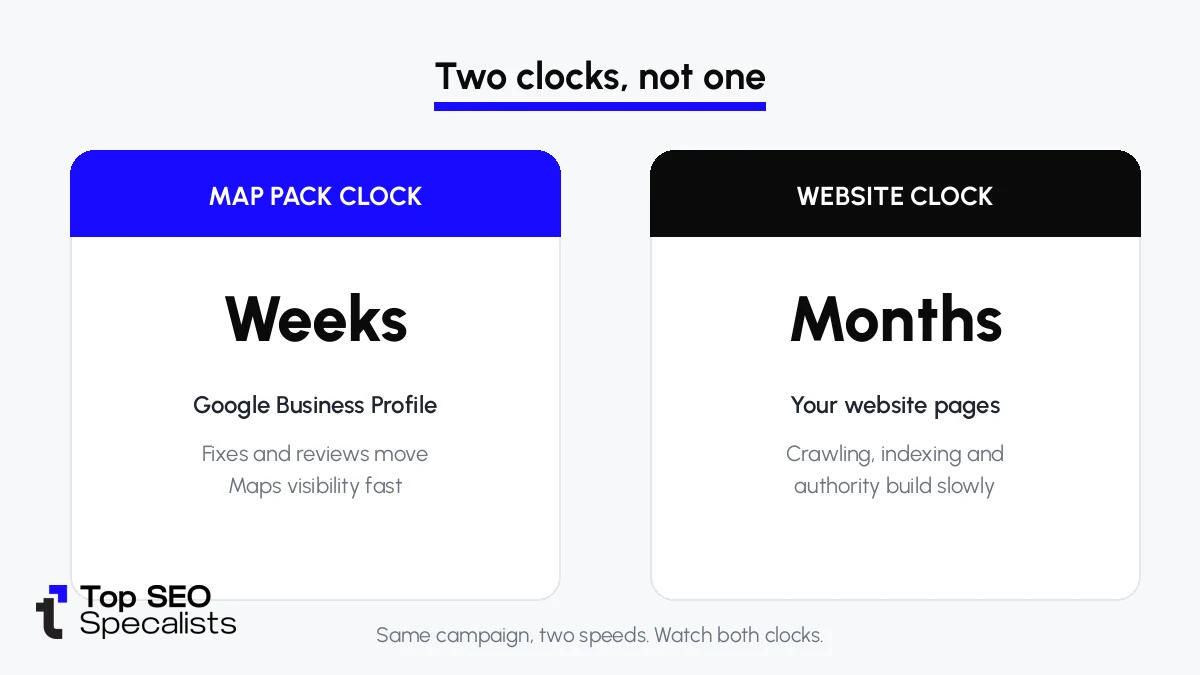
Two clocks, not one. The Map Pack can move in weeks; website rankings take months.
The New Zealand clock, month by month
There is no NZ-wide study that measures how long local SEO takes for New Zealand businesses. No regulator or standards body publishes a universal number of months, and no New Zealand agency has published timing data from a large sample of local campaigns. Saying otherwise would be inventing data. The timeline below is built from what NZ agencies do publish, from Google’s own guidance, and from one published NZ case.
Months 0 to 1: foundation
The first month is mostly work you cannot see in the rankings: establishing a baseline, auditing your Google Business Profile and its categories, auditing the website for crawl and indexing problems, reviewing service pages, checking citations, and setting up measurement.
You should not expect ranking changes yet. The aim is to give every future improvement a sound base.
Months 1 to 3: early signals
This is when the quiet signs should start showing up: your key pages get indexed, Search Console starts recording impressions for more searches, your Business Profile shows more views and actions, and you start ranking for specific, low-competition searches.
Do not judge this stage by your hardest keyword. A search like a particular service plus your town has less competition than a broad “near me” search.
Months 3 to 6: meaningful results
For many businesses, this is when local SEO becomes easier to judge commercially. Rankings for target keywords should be solidifying, Map Pack appearances for priority searches should be more consistent, and calls from organic search should be measurably increasing.
Months 6 to 12: stability and growth
The longer timeline matters when you are taking visibility from businesses with strong local authority. At this stage the work is continuing content, stronger service pages, more reviews, and relevant local links.
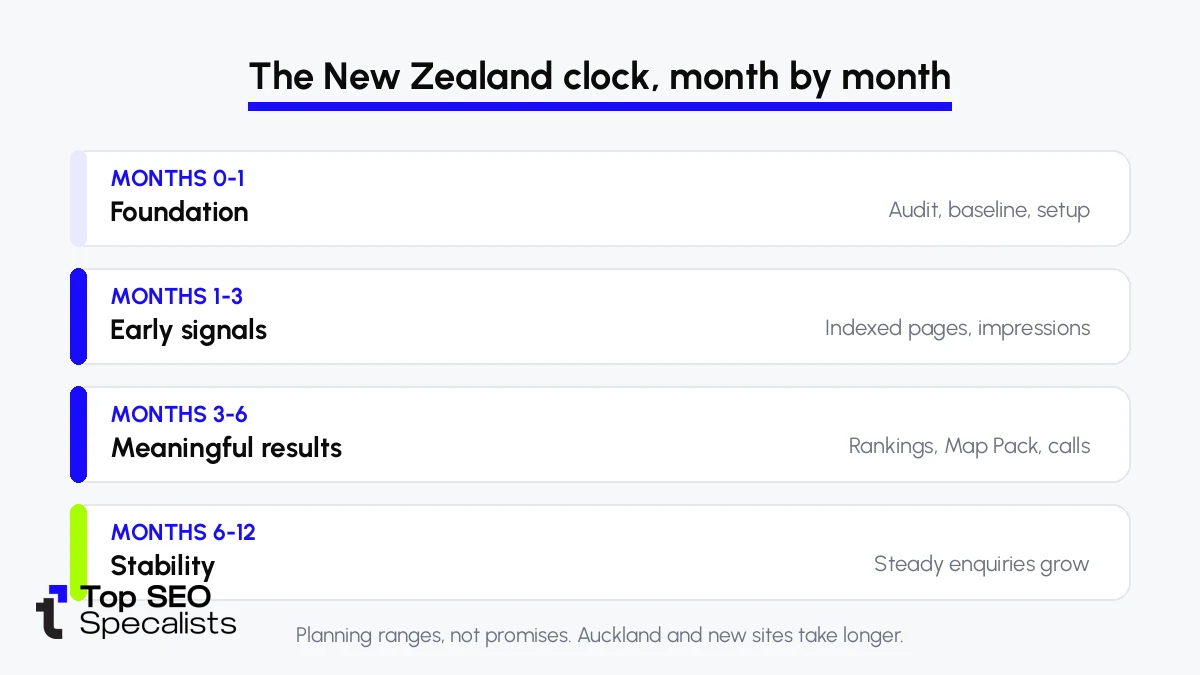
The New Zealand clock, month by month. Foundation first, then signals, then results.
One published NZ case shows what the long clock looks like in practice. Savvy Yards, a New Zealand agency, published a case study of a custom print business in Onehunga, Auckland. The business started with near-zero organic visibility, around 200 monthly clicks and an average ranking position of 45.5, roughly page five of Google. Over a 15-month organic program, organic users more than doubled, Top-3 keywords more than tripled, and average position rose to page two. Local and technical wins surfaced in the first few months, but durable results built over 6 to 12 months.
What decides where you land in that range?
Seven factors decide most of it.
1. Your starting point. A business with a healthy website, an established Business Profile, and existing local visibility starts from a very different position than a new business with no authority. If your profile is poorly categorised or your important pages are not indexed, fixing those problems may create movement faster than building authority from scratch.
2. Your competition. Ranking for a dentist in a small town is different from competing for a personal injury lawyer in a major city. Look at who already ranks: how established are their websites, how strong are their service pages, how many relevant reviews do they have? The stronger the incumbents, the more work it takes to displace them.
3. Your Google Business Profile. Your profile is central to local visibility. Google says local ranking is mainly based on relevance, distance, and prominence. The areas that matter are the correct primary category, accurate business information, appropriate services, correct hours, genuine photos, genuine reviews, and a correct connection to your website.
4. Reviews. Reviews influence both customer trust and local visibility. Google says review count and positive ratings can contribute to local prominence. What matters is a healthy, genuine process for requesting and receiving customer feedback over time. One NZ agency notes: a business with 40 reviews and a 4.6 average will often beat a business with 8 reviews and a 5.0 average, because review volume signals trust.
5. Your website and service pages. Local SEO is not only about Maps. Your website still has to explain what you offer, which problems you solve, who you serve, and where you operate. A service page that only swaps city names into a generic template is unlikely to provide the same value as a page with genuine service information and local context.
6. Citations and local authority. Consistent business information across important directories helps Google confirm that your business exists and is legitimate. In New Zealand the main directories are Yellow NZ, Localist, Finda, and NoCowboys for the trades, plus industry directories such as Builderscrack for builders. Ten relevant, accurate listings are more useful than hundreds of poor-quality directory submissions.
7. Technical SEO. A local campaign can underperform because the underlying website has problems: important pages not indexed, broken internal links, incorrect canonicals, redirect problems, slow pages, or mobile usability issues.
How long does local SEO take in Auckland vs a smaller town?
This is the question NZ owners actually need answered, and it is the one most guides skip. An emergency plumber in Auckland competes with businesses that have years of reviews, service pages, local mentions, and useful content. A specialist drainlayer in a smaller regional market may face a handful of competitors, some with half-finished profiles.
The NZ guidance is consistent on the split. For an established local business with a sound website, early signs come in 1 to 3 months and meaningful results in 3 to 6 months. For a new local business or a new domain, early signs come in 2 to 4 months and meaningful results in 6 to 12 months. For a competitive trade in a major city, early signs come in 3 to 6 months and meaningful results in 6 to 12 months or longer.
Proximity also compresses the timeline in a way that has nothing to do with how good your SEO is. Google’s local algorithm heavily weights how close a searcher is to your business. That is why map results change street by street, and why “number one” means little without saying where the searcher was standing.
How do you know if local SEO is working?
Leads matter most, but they are a lagging outcome. If you only measure leads, the first three months will look like nothing is happening even when the campaign is on track. Measure the progression instead: crawl and indexing, then impressions, then query coverage, then rankings, then Map visibility, then website actions, then calls and enquiries, then customers.
Here is a fifteen-minute check you can run yourself, once a month, using two free Google tools.
Minutes 1 to 5: compare two complete months in Search Console. Open the Performance report, set a date comparison between your first complete month and your latest complete month, and write down clicks, impressions, click-through rate, and average position. Then open the Queries and Pages tabs and note the searches and pages that changed the most. Never compare an incomplete month or two periods of different lengths.
Minutes 6 to 9: inspect your most important pages. Run URL Inspection on your homepage and your main service page. Confirm each one says it is indexed.
Minutes 10 to 13: compare the same months in your Business Profile. Open your profile’s Performance section and compare the same two months for views, searches, calls, website clicks, and direction requests.
Minutes 14 to 15: write it all down. Record the exact date ranges, where you saved screenshots or exports, and every piece of work your provider says it completed.
The month four evidence test
By month four, you should have evidence, not leads. Leads are not guaranteed by month four, and any provider who promised them by then was guessing.
| By month four, you should have | Where to check |
|---|---|
| A dated list of completed work, with the pages changed | Your provider’s report, or your own notes |
| Owner access to Search Console and your Business Profile | Account user settings, from the start |
| A baseline month recorded before work began | The first complete month of data |
| Key service and contact pages indexed | Search Console URL Inspection |
| Impressions compared across two complete periods | Search Console Performance |
| Profile views and actions compared | Business Profile Performance |
And two things are not guaranteed yet: a steady flow of calls and leads from search, and top-three map placement for broad terms. Those depend on demand, distance, competition, and how you handle enquiries, which is why the honest range stretches to a full year.
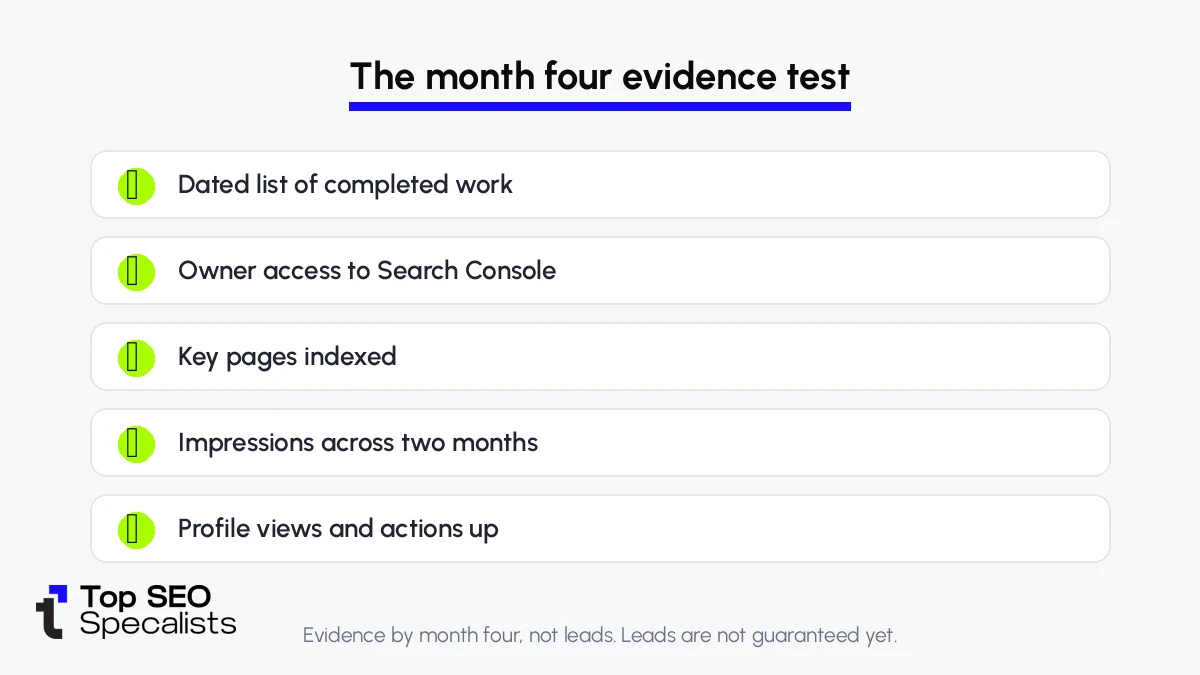
The month four evidence test. Evidence by month four, not leads.
What can speed local SEO up, and what slows it down?
You cannot force Google to rank a page by a particular date. But you can remove avoidable delays.
• Fix technical and indexing problems first. A useful page cannot perform if Google cannot crawl it, chooses a different canonical, or repeatedly encounters server errors.
• Prioritise high-intent service pages. A local business will usually gain more from a strong page for a profitable service than from a broad blog post with no connection to what it sells.
• Strengthen internal links. Link related services and guides using descriptive anchor text. This helps visitors find the next useful page and gives search engines clearer context about how the topics relate. If you are not sure where to start, our SEO service covers the site structure that supports local rankings.
• Earn relevant mentions and links. Industry organisations, suppliers, local news, partnerships, and useful original resources can all create credible references. A few relevant links are more valuable than a large batch of unrelated directory or paid links. If you want help with the profile, reviews, and local evidence side, our local SEO service covers it as part of the work.
• Work consistently and review the data. Use Search Console to find pages gaining impressions but few clicks, queries sitting close to page one, and important topics your site does not answer properly.
One thing that does not speed it up is Google Ads. Paying for ads does not directly improve organic rankings. Google states that advertising does not affect a site’s presence in organic search results.
When should you worry?
Slow progress leaves a paper trail. You can see what was changed, when, and what happened to the numbers afterward, even when the numbers are still small.
The red flags are specific. Guaranteed number one rankings: nobody controls Google’s results, and Google says no one can guarantee a first-place ranking. Fake or bought reviews: Google removes them and can restrict the profile. Hundreds of citations for a small monthly fee: bulk listings on low-quality directories add nothing and leave inconsistent details to clean up later. Keywords stuffed into your business name: a listing called “Plumber Auckland Emergency 24hr” breaks Google’s guidelines and is one of the most common reasons for suspension. Your profile sitting in the agency’s ownership: if the agency owns your Google Business Profile, it owns your reviews and your map presence. Reports with rankings but no enquiries: a list of keyword positions says nothing about calls or booked work.
Three months with no movement in Business Profile impressions, no new keyword appearances in Search Console, and no review growth is a sign the work may be insufficient or misdirected.
Frequently asked questions
For most New Zealand businesses, expect early signs within 1 to 3 months and more meaningful traffic and enquiry growth in 3 to 6 months. New websites and highly competitive markets can take 6 to 12 months or longer.
Google Maps can move faster than website rankings because it runs on your Google Business Profile rather than your website. Profile fixes and a steady flow of genuine reviews can improve your Maps visibility within a few weeks.
Three months is within the normal pre-results window for most businesses, particularly those starting from a low base. But if you are seeing no movement in Business Profile impressions, no new keyword appearances in Search Console, and no review growth, the work may be insufficient or misdirected rather than simply slow.
Not in the way the promise usually means. Profile fixes can improve your Maps visibility within weeks, and a business with an obvious, fixable problem can move quickly. But meaningful rankings and steady enquiries cannot be promised in 30 days.
Reviews build prominence over time, with no fixed number of days after which they start counting. Google says review count and positive ratings can contribute to local prominence. What matters is a steady, genuine flow: asking every satisfied customer and replying to every review.
You can remove avoidable delays but you cannot shortcut the trust-building part. Fix technical and indexing problems first, prioritise high-intent service pages, strengthen internal links, keep your Business Profile accurate and active, and earn relevant local mentions.
No. Google states that advertising does not affect a site’s presence in organic search results. Ads can generate leads within days and show which search terms produce enquiries, but the SEO clock runs on its own schedule.
Watch the signals in the order they appear: indexed pages first, then Search Console impressions and query coverage, then rankings for specific service searches, then Business Profile views and actions, then calls and enquiries. Run the fifteen-minute monthly check in this article and compare complete months, not single weeks.
What to do next
Local SEO takes as long as it takes to build the evidence Google needs: a complete profile, genuine reviews, consistent business details, useful pages, and a history of all of it being maintained. In New Zealand that usually means weeks for the Map Pack, 3 to 6 months for meaningful rankings, and 6 to 12 months for steady enquiries. If nothing is moving by month four, the problem is not the calendar. It is the work.
If you want an honest read on where your business sits on this timeline, start with a free audit. We will look at your profile, your pages, and your starting position, and tell you what should move first.
Want an honest read on your timeline?
Tell us where your business sits and we will look at your profile, your pages, and your starting position, and tell you what should move first.
Keep reading
The Map Pack side, in detail.
What to ask before you hire anyone.
The service that does this work.