
How Much Does a Website Cost in NZ? Real 2026 Prices and the Costs Nobody Quotes
4 November 2026 · By Top SEO Specialists
In New Zealand in 2026, a professionally built small business website typically costs between $3,000 and $15,000 plus GST. Most established businesses land between $4,000 and $9,000 plus GST for a 5 to 8 page site. DIY builders start near $0 but cost you evenings instead. Online stores run $5,000 to $50,000 plus GST depending on size and complexity. And whatever the build price, budget $300 to $1,800 a year on top for hosting, domain, and maintenance, because almost no quote includes all three.
Key Takeaways
✓ A professional NZ small business website costs $3,000 to $15,000 plus GST in 2026, with most quality builds landing at $4,000 to $9,000 plus GST (Meta Digital, Fuel Design, Mica Group, 2026 published pricing).
✓ The build price is rarely the full price. Hosting ($25 to $150+ a month), domain ($25 to $60 a year for .co.nz), and maintenance are usually quoted separately.
✓ Two quotes for “the same” website can differ by $10,000 because they describe different things: strategy, custom design, copywriting, SEO setup, and support are either in or out.
✓ A $99 a month subscription site costs $3,564 over three years and you own nothing at the end. Run the 3-year maths before you sign.
✓ Almost every NZ quote excludes the 15% GST. Add it yourself before comparing numbers.
✓ The cheapest protection against a bad buy is a clear brief: what the site is for, roughly how big, who provides the content, your timeframe, and your budget band.
How much does a website cost in NZ in 2026?
Here are the honest bands, drawn from what New Zealand agencies and freelancers published in 2026. Treat them as a map of the market, not a quote. Every figure below excludes GST unless stated, because that is how most NZ firms quote (Refined Group, 2026).
| Type of website | Typical 2026 range (excl. GST) | Best for |
|---|---|---|
| DIY builder (Wix, Squarespace) | $0 to $60/month | Testing an idea, very tight budgets |
| Template or package site | $600 to $3,000 | Getting online fast with a professional look |
| Freelancer custom build | $1,500 to $4,000 | Straightforward sites on a moderate budget |
| Small business site, agency-built (5 to 8 pages) | $3,000 to $15,000 | Established businesses that need enquiries |
| Custom lead-generating site | $9,000 to $30,000+ | Businesses where the site is a core sales channel |
| Online store | $5,000 to $50,000+ | Selling online, from simple Shopify to custom platforms |
The band most NZ businesses ask about is the agency-built small business site. The published consensus is unusually tight: Meta Digital puts it at $3,000 to $15,000, Fuel Design at $3,990 to $8,000, Mica Group at $2,500 to $8,000, and Horntech at $3,000 to $8,000. Most quality builds land between $4,000 and $9,000 plus GST. That buys a professionally designed, mobile-responsive site with a content management system, contact forms, basic SEO setup, and training so you can edit it yourself.
The width of the ranges is not agencies being cagey. A website is not one product. A two-page template and a custom store with Xero integration are both “websites” the way a sleepout and a five-bedroom home are both “houses”. The rest of this guide shows what moves you up or down the bands.
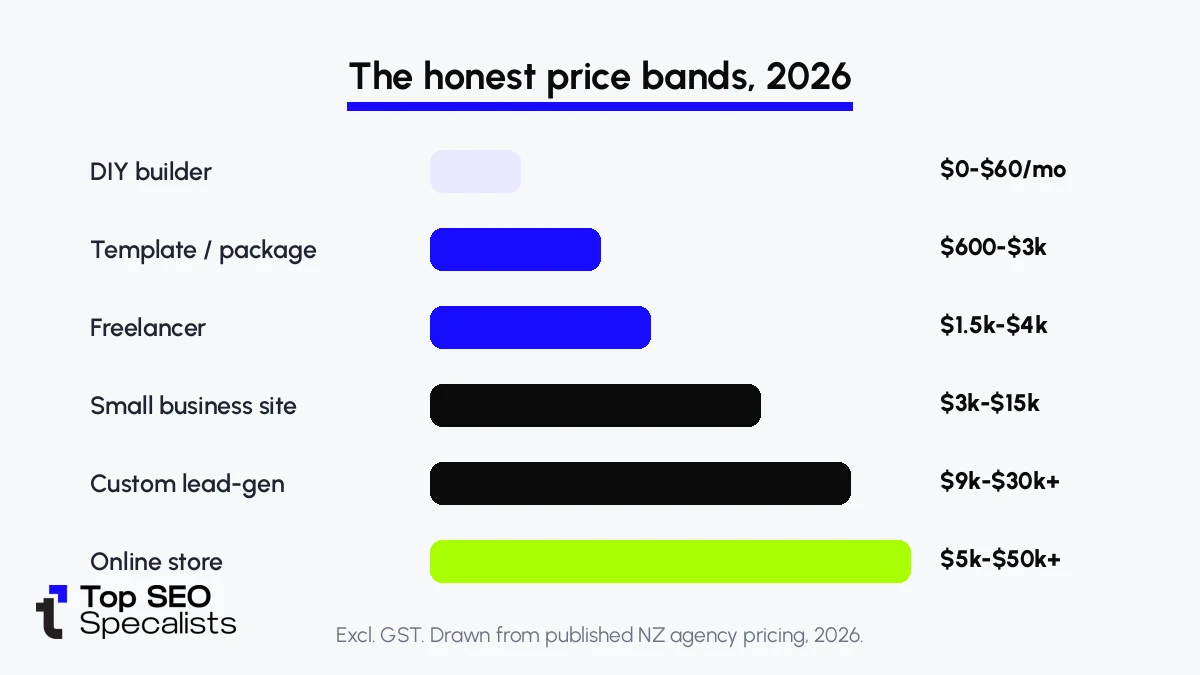
The honest 2026 price bands, drawn from published NZ agency pricing.
What do you actually get at each price?
Price only makes sense next to what is included. Here is the same market, compared on what you give up at each level.
| DIY builder | Freelancer | Small agency | Subscription | |
|---|---|---|---|---|
| Upfront cost | $0 | $1,500 to $4,000 | $3,000 to $15,000 | $0 |
| Monthly cost | $20 to $60 | $0+ | $0+ | $95 to $209 |
| Design | Template you customise | Custom or semi-custom | Custom, designed around your business | Template, theirs |
| SEO setup | Basic at best | Sometimes included | Usually included | Varies |
| You own | Your content, not the platform | The site, fully | The site, fully | Nothing if you stop paying |
| Best for | Testing an idea | Simple sites, tight budgets | Businesses that need enquiries | Cash flow over ownership |
Two rows in that table deserve a closer look, because they are where NZ businesses most often miscalculate: the ongoing costs, and the subscription trap.
What are the ongoing costs nobody puts in the quote?
The build price gets the attention. The ongoing costs decide what the site actually costs you per year. Almost every NZ agency quotes these separately, and some quotes leave them out entirely (Refined Group, 2026).
• Hosting: $25 to $150+ a month. The rent for the server your site lives on. Basic shared hosting sits at the bottom; managed hosting with speed optimisation, security, and backups sits at the top. For a standard business site, expect $40 to $150 a month from a professional provider (Meta Digital, 2026).
• Domain name: $25 to $60 a year. A .co.nz domain typically costs $25 to $40 a year (Refined Group), up to $60 at some registrars (Reverb, 2026). Register it yourself, in your own name. This is the single most important ownership rule on this page: if your web company registers your domain on their account and you part ways, getting it back can be a fight.
• Maintenance: $50 to several hundred a month. Updates, security patches, backups, uptime monitoring, and small content changes. Skip it and the site still works, until the month a plugin update breaks the contact form and nobody notices for six weeks.
• SSL certificate: usually $0. Most hosts include it free now. If someone quotes you $250 a year for a standard certificate on a brochure site, ask why (Avoca Design, 2026).
• GST: add 15%. Most NZ web quotes exclude GST. A $6,000 quote is $6,900 out of your account if you are not GST registered. Always add it before comparing two numbers (Refined Group; Reverb, 2026).
Add it up and a typical small business site costs $300 to $1,800 a year to keep alive after the build, before you change a single word.
Why do two quotes for the same website differ by $10,000?
Because they are rarely quotes for the same website. When one quote says $4,000 and another says $14,000, the difference is almost always in what is included. Here are the five levers that move an NZ quote, with the itemised figures Lucid Media published in 2026:
• Pages beyond the baseline: $180 to $320 per page. A five-page site and a fifteen-page site are different jobs. But page count is a rough guide: one carefully crafted landing page can take longer than five simple ones.
• Taking payment online: $1,500 to $3,500 as an add-on. Payments, product setup, shipping, and checkout testing are real engineering, not a plugin toggle.
• Copywriting: $375 to $850. Words are half of any website. If you supply polished copy, you save real money. If the agency writes it, that is professional work with a price. Our content writing service exists because most businesses underestimate this line item until quote day. If you are not sure which writer you need, our guide to content writing vs copywriting walks through the difference.
• Custom integrations: $1,200 to $3,500. Booking systems, CRMs, Xero, membership logins. Each one is a feature to build, test, and maintain.
• SEO setup at launch: $500 to $1,000. Technical foundations, page titles, site structure, speed work. The cheapest quotes almost never include it, which is how a $4,000 site ends up invisible on Google. Our web development service includes SEO groundwork as standard, because a site nobody can find is an expensive business card.
There is also a quieter lever: strategy. The most valuable work often happens before a single page is designed. Who is the site for, what is the one action that matters, how does a visitor become an enquiry? A site built on that thinking costs more than one that skips it, and it is the difference between a website that looks nice and one that brings in work (Meta Digital, 2026).
So when quotes diverge, do not ask “which one is right?” Ask “what is in each one?” Line the inclusions up side by side. The $14,000 quote with strategy, copywriting, SEO setup, and a year of support can easily be better value than the $4,000 quote that is design and build only.
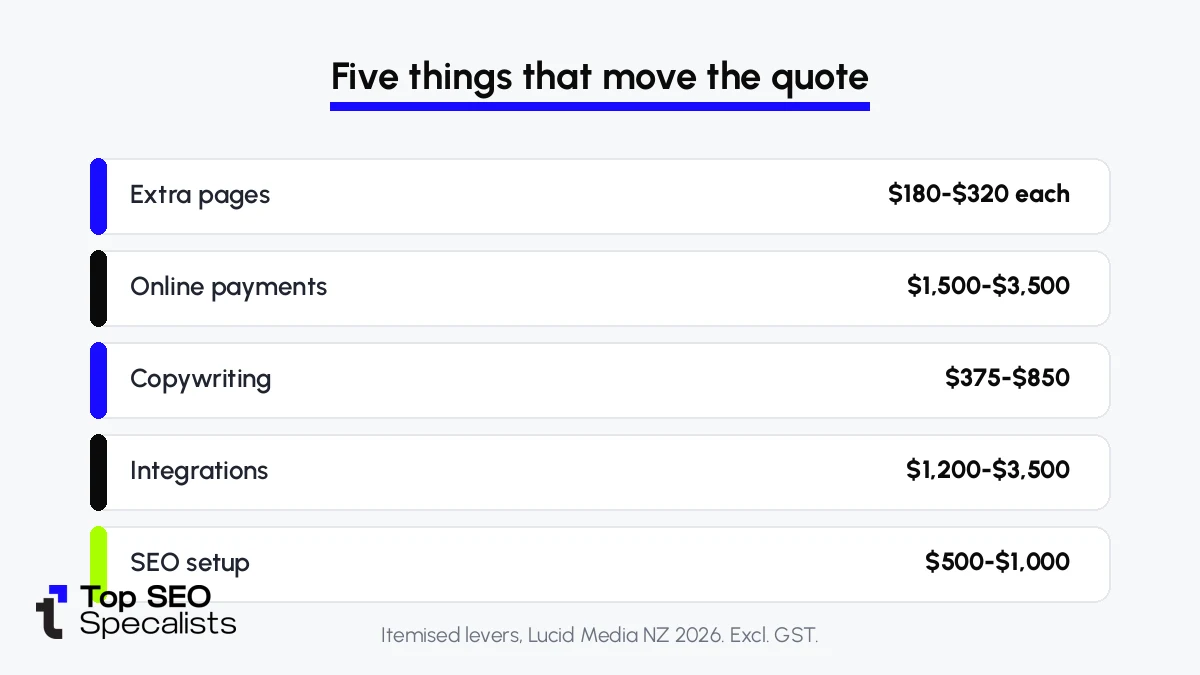
Five itemised levers that move a New Zealand website quote (Lucid Media, 2026).
The 3-year maths: what each option really costs
This is the comparison no NZ pricing guide runs, and it is the one that matters. A website is not a one-time purchase; it is a three-year commitment at minimum. Here is the honest total for a typical small business site, using midpoints of the published 2026 ranges, all figures including 15% GST.
| Year 1 (build + ongoing) | Years 2 to 3 (ongoing) | 3-year total (incl. GST) | You own at the end | |
|---|---|---|---|---|
| DIY builder ($40/mo) | $552 | $1,104 | $1,656 | Your content only |
| Freelancer ($2,750 + $600/yr care) | $3,853 | $1,380 | $5,233 | The whole site |
| Small agency ($6,500 + $1,200/yr care) | $8,855 | $2,760 | $11,615 | The whole site |
| Subscription ($150/mo, no upfront) | $2,070 | $4,140 | $6,210 | Nothing |
Read that last row twice. The subscription looks like the cheap option in year one. By the end of year three you have paid $6,210, more than the freelancer path, and you own nothing you can sell, move, or keep. Stop paying and the site disappears. That is not a website purchase. It is a rental agreement wearing a website costume.
The maths is illustrative, not a quote: your numbers will differ. But the shape of it does not change. Ownership has a higher first year and a falling cost curve. Rentals have a low first year and a cost curve that never falls. The right choice depends on your cash flow and your timeframe, but make it with the full three years in front of you, not just the first invoice.
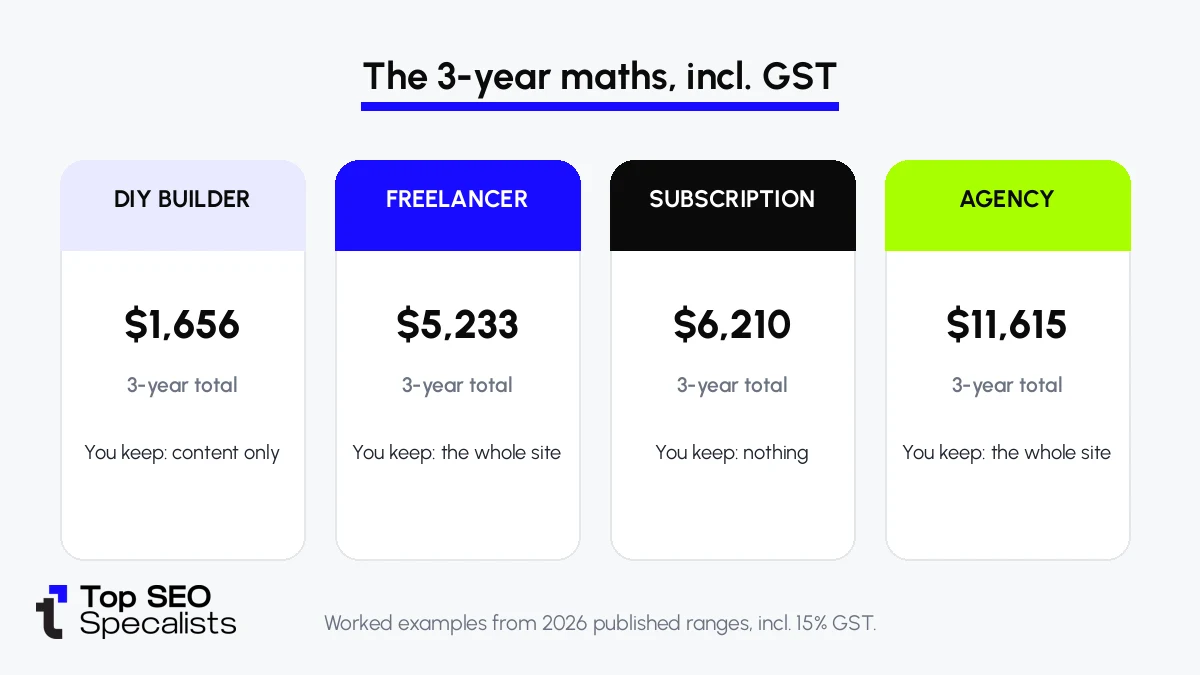
Three-year true cost including GST: owning a website versus renting one.
Is a cheap website or DIY builder worth it?
Sometimes, and the honest answer depends on what the site has to do.
A DIY builder is a fair trade when you are testing an idea, the site is a secondary priority, and your evenings are cheaper than your dollars. What it costs you is time, a generic look, and usually weak SEO foundations. For a brand-new side project, that can be the right call.
A cheap template site from a budget provider is worth it when you need to look legitimate fast and the site only has to do one job: prove you exist. Where it goes wrong is the rebuild tax. A $900 template site that cannot rank, cannot take bookings, and cannot grow gets replaced within two years by the $6,000 site you should have bought first. The cheapest quote plus the rebuild costs more than the right quote once (Alignable small-business forum, 2026).
The subscription model is worth it when cash flow is the binding constraint and you go in with open eyes: you are renting, the monthly fee is permanent, and leaving means rebuilding from zero. It is not worth it when you believe you are “buying a website with no upfront cost”. You are not. Read the contract for who owns the domain, the content, and the design if you cancel.
And a word on the Auckland question, because it comes up: the same 8-page site costs roughly $6,500 to $10,000 in Auckland and $5,000 to $8,500 in Christchurch, with regional NZ 10 to 20 percent cheaper than Auckland for equivalent scope (Horntech, 2026). Price follows wages and overheads, not talent. A Christchurch or regional studio is not a discount option; it is the same work with lower rent behind it.
How do you get an accurate quote?
You do not need a technical spec. You need to describe five things clearly, and any web partner worth hiring will ask for them before quoting (Meta Digital, 2026):
✓ What the website is for. More enquiries? Online sales? Credibility? Bookings? The job decides the build.
✓ Roughly how big it is. A ballpark page count and any must-have features, like payments or a booking system.
✓ Who provides the content. Do you have copy and images ready, or do you need help? This single answer moves quotes by hundreds or thousands.
✓ Your timeframe. A launch date changes resourcing and price.
✓ Your budget band. Even a rough range helps. It tells the provider what scale of solution to propose, so the quote comes back realistic instead of aspirational.
Sharing a budget can feel like tipping your hand. Silence helps no one: without it you get a proposal that misses in either direction, too grand or too thin. A fixed price for an agreed scope, confirmed before work starts, is the arrangement to ask for. If the goalposts move mid-project, that gets discussed first, not invoiced later.
One more check before you sign anything: who owns what. Your domain in your name, your content exportable, your site movable to another host. The businesses that get burned are rarely burned by the price. They are burned by discovering, two years in, that they never owned the thing they paid for.
Frequently asked questions
Most small business websites in New Zealand cost between $3,000 and $15,000 plus GST in 2026, with quality 5 to 8 page builds typically landing at $4,000 to $9,000 plus GST. Template-based sites cost less, and lead-focused or feature-rich sites cost more. The right number depends on what you need the site to do.
Because “a website” describes everything from a one-page template to a custom online store with integrations. The range reflects real differences in strategy, custom design, copywriting, functionality, SEO setup, and ongoing support. A higher price usually buys more of the work that makes a site perform, not just more pages.
Budget $300 to $1,800 a year on top of the build: hosting at $25 to $150+ a month, a .co.nz domain at $25 to $60 a year, and maintenance at $50 to several hundred a month. Almost no build quote includes all three, so add them yourself before comparing quotes.
In dollars, yes: a DIY builder costs $20 to $60 a month. In total cost, often no. You trade money for evenings, and you usually end up with a generic-looking site with weak SEO foundations that needs rebuilding once the business depends on it. DIY is a fair trade for testing an idea, not for a site that has to win customers.
Not automatically. The cheapest quote often leaves out the things that make a website work: strategy, custom design, copywriting, SEO setup, and support. Compare what is actually included, not just the bottom-line number. The best value is the site that does its job for years, not the one that was cheapest to launch.
A basic Shopify or WooCommerce store starts around $5,000 plus GST; a well set-up store with proper product, payment, and shipping configuration typically runs $5,000 to $15,000 plus GST. Advanced stores with integrations, large catalogues, or custom workflows run $15,000 to $50,000 plus GST.
Usually not. Most monthly website plans are rentals: you are paying for hosting, maintenance, and the right to use their platform. Stop paying and the site disappears. Over three years a $150 a month plan costs $6,210 including GST and leaves you owning nothing. If ownership matters, check the contract for who owns the domain, content, and design on cancellation.
A landing page takes 1 to 2 weeks; a small business site takes 4 to 6 weeks; a larger or ecommerce build takes 6 to 16 weeks. The timeline stretches most when content is not ready, so having your copy and images prepared before the build starts is the fastest way to hit a launch date.
What to do next
If you are weighing this decision, run the 3-year maths from this guide on every quote you receive: build price plus three years of hosting, domain, and maintenance, all including GST. Then line up what is actually included in each quote. The number that matters is total cost of ownership against the job the site has to do.
If the numbers point to a professionally built site, our web development service builds custom, fast, SEO-ready websites with fixed pricing agreed before work starts. If the site needs to earn its keep on Google from day one, our SEO services start with a technical audit, and our local SEO service covers the Google Business Profile work that turns “near me” searches into calls.
Or skip the guesswork and get the audit first: a free, no-obligation look at where your current site stands, what is broken, and what your next website should actually cost. Get a free audit.
Planning a new website? Start with the real number.
Tell us what the site has to do and we will give you an honest, itemised figure, no jargon and no surprises.
Keep reading
The traffic your new site has to convert.
Who writes the words is half the quote.
Custom, fast, SEO-ready builds.