
WordPress vs Custom Website: Which Should Your New Zealand Business Build in 2026?
4 November 2026 · By Top SEO Specialists
Choose WordPress when your website mainly presents your business: service pages, a blog, a booking form, a small shop. It launches in weeks, your team can edit it, and professional NZ builds run NZD $3,000 to $15,000. Choose a custom-built website when the site has to do complex work: user accounts, custom workflows, deep system integrations, or serious scale. That costs several times more and takes months, but nothing else does the job. Most New Zealand businesses need the first one, built properly.
Key Takeaways
✓ The real choice is three-way, not two-way: template WordPress, custom WordPress theme, or fully custom-built site. Most “custom” quotes are really the first one.
✓ WordPress powers about 43% of all websites (W3Techs 2026). For a marketing site, that is not a compromise, it is the default for a reason.
✓ In New Zealand, professional business websites typically cost NZD $3,000 to $15,000 and take 3 to 6 weeks on WordPress.
✓ A well-built WordPress site beats a badly built custom site every time. Build quality decides more than the platform name.
✓ Custom earns its price when the website is the product: portals, marketplaces, SaaS, complex integrations.
✓ The most expensive mistake is paying custom prices for a template with your logo swapped in.
What do “WordPress” and “custom website” actually mean?
WordPress is an open-source content management system. You install it on web hosting, choose a theme for the design, add plugins for features like forms, SEO, or a shop, and your team edits pages through a dashboard without touching code. The software itself is free. You pay for hosting, premium plugins, and someone to set it up properly. About 43% of all websites run on it (W3Techs 2026), which means developers, themes, plugins, and help are easy to find.
A custom website is built from scratch for one business. A developer plans the structure, designs the screens, and writes the code to match your exact requirements, usually with modern frameworks like React, Next.js, or Laravel. Nothing is there because a template happened to include it. Most custom builds include an admin panel so your team can still edit content, but structural changes go through the developer.
Here is the part the ranked guides skip, and it is the most important paragraph in this article. When a New Zealand business asks for “custom”, they are usually choosing between three things, not two: a template WordPress site (a purchased theme configured with your content), a custom WordPress theme (designed and coded around your business, still running on WordPress), or a fully custom-built site (no WordPress at all, purpose-built software). As one agency with decades on the platform puts it, many “custom” quotes are really the first option wearing the third option’s price tag. Knowing which of the three you are actually being offered is worth more than any comparison table.
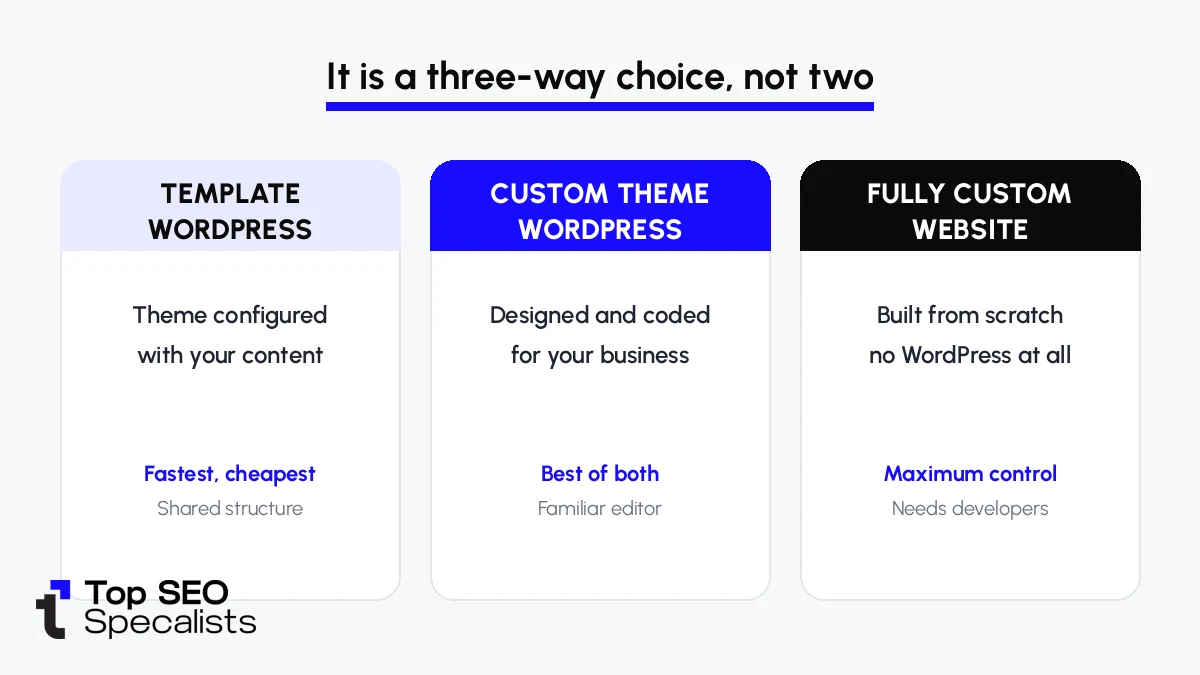
Three options, not two. Know which one your quote is actually selling.
WordPress vs custom website: the head-to-head comparison
Here is how the two platforms compare across the dimensions that actually decide the outcome:
| WordPress | Custom-built website | |
|---|---|---|
| Upfront cost | Lower; themes and plugins save build time | Higher; every feature built by hand (2 to 4x for a standard site) |
| Time to launch | Weeks (3 to 6 for a standard NZ business site) | Months (8 to 24 weeks typical) |
| Design freedom | High with a good developer; limited by theme otherwise | Complete; blank page, built for your brand |
| Content editing | Easy; the dashboard is built for non-technical editors | Depends on the admin panel built for you |
| Speed | Good with a proper build; page builders can drag it down | Excellent by default; only the code it needs |
| SEO | Excellent; plugins handle titles, sitemaps, schema | Excellent with the right implementation; full control |
| Security | Core is solid; risk sits in outdated plugins and weak passwords | Smaller attack surface, but only as safe as its developers |
| Maintenance | Regular updates to core, theme, plugins | Updates on your schedule; depends on the original team |
| Scalability | Good, with a ceiling for complex application logic | Built for your specific scale |
| Developer dependency | Low; a huge talent pool | High; tied to the stack and the team that built it |
The table tells you what each platform is. The next sections tell you which one your business actually needs, because the honest answer depends on what the website has to do.
When WordPress is the right choice
WordPress is the smart pick when most of these describe you:
• Your site explains and converts. Service pages, about page, testimonials, blog, contact form, maybe a booking widget. That describes most tradies, clinics, law firms, consultants, and local retailers in New Zealand.
• Your team will edit it. Add a blog post on Tuesday, change the holiday hours, swap a team photo. The WordPress editor is the most familiar in the world, and your office manager can learn it in an afternoon.
• Your budget is under about NZD $15,000. Professional NZ business websites typically run NZD $3,000 to $15,000. At that range WordPress gives you the best value per dollar.
• You need it live soon. Three to six weeks is normal for a standard WordPress business site. Custom projects rarely finish under two months.
• Content is your growth channel. WordPress was built for publishing. If blogging and resources are how you win customers, its editor, SEO plugins, and content workflow are unmatched.
One honest caveat from the practitioner threads: what sinks WordPress sites is not WordPress, it is the build. A cheap site with a bloated multipurpose theme and forty plugins on budget hosting will be slow and fragile. A custom or lightly customised theme, under ten plugins, managed hosting, and monthly updates is a different machine entirely. When someone tells you “WordPress is slow”, ask what their last WordPress site was built on.
When a custom website is worth the money
Custom development earns its higher price in specific situations:
• The website is the product. A booking platform, a customer portal, a marketplace, a SaaS dashboard. If customers log in and do things, WordPress plugins will fight you every step.
• You need user accounts and permissions. Member dashboards, tiered access, team accounts with invitation systems. WordPress user roles approximate this but do not cleanly implement it.
• Deep integration with your systems. Your inventory, CRM, ERP, or field-service software. Plugins cover the big names; for proprietary or mid-market systems, custom integration is cleaner and does not depend on a third-party developer keeping a plugin alive.
• Performance at serious scale. If the site is your main lead channel and every 100ms of load time costs conversions, a custom front end built to spec will beat a plugin-heavy WordPress site consistently.
• Regulated or sensitive data. Healthcare, finance, legal. WordPress can be secured, but its popularity makes it the most-targeted platform on the web, and every plugin is an attack surface. Fewer moving parts means fewer things to audit.
A practical rule from an agency that builds both: if more than a third of your site’s pages require logged-in users or custom logic, get a custom quote. If it is mostly content with a feature or two, build it on WordPress. And be suspicious of anyone who only sells one of the two.
The middle paths most guides bury
It is not always either-or, and the best answer for many NZ businesses sits between the poles:
• Custom WordPress theme. WordPress underneath, but the theme is designed and coded for your business instead of purchased. You keep the familiar editor; you lose the bloat. This is what “custom WordPress development” should mean.
• Custom features on WordPress. WordPress manages the content while a developer builds custom plugins or integrations on top. A furniture brand keeps its blog in WordPress while a developer builds a custom room-planner tool, for example.
• Headless WordPress. WordPress runs quietly in the back as the content editor; a custom front end serves the pages. You get the editing experience your team knows plus custom-site speed. You also pay custom-site build costs, so it is overkill for a ten-page site.
A smart path many businesses take: start on WordPress to prove the idea, then build custom parts only where they bring real value. You do not have to pick your forever platform on day one.
The template trap: what “custom” sometimes really means
This is the section that saves real businesses real money, and it comes straight from conversations we have with NZ owners every week.
“We paid a lot and got a template.” We hear it constantly. A business pays premium pricing, expecting bespoke work, and receives a generic purchased theme with their logo swapped in. That is not custom development. It is a markup on someone else’s work.
How to protect yourself, whichever platform you choose:
✓ Ask what “custom” means in the quote. Custom theme designed for you, or premium theme configured for you? Get it in writing.
✓ Ask how many plugins, and which ones. A WordPress quote with 30+ plugins is a maintenance liability wearing a low price tag.
✓ Ask who edits it afterwards. If the answer is your developer at an hourly rate for a text change, you are buying dependence, not a website.
✓ Ask for the handover package. Source code, database, hosting details, documentation, admin logins.
✓ Compare like with like. A $4,000 template WordPress site and a $25,000 custom build are not competing quotes. They are different products.
The cheapest protection is the three-way test from earlier in this article. Before you sign, write down which of the three you are buying: template WordPress, custom WordPress theme, or fully custom-built site. If the quote cannot answer that clearly, walk away.
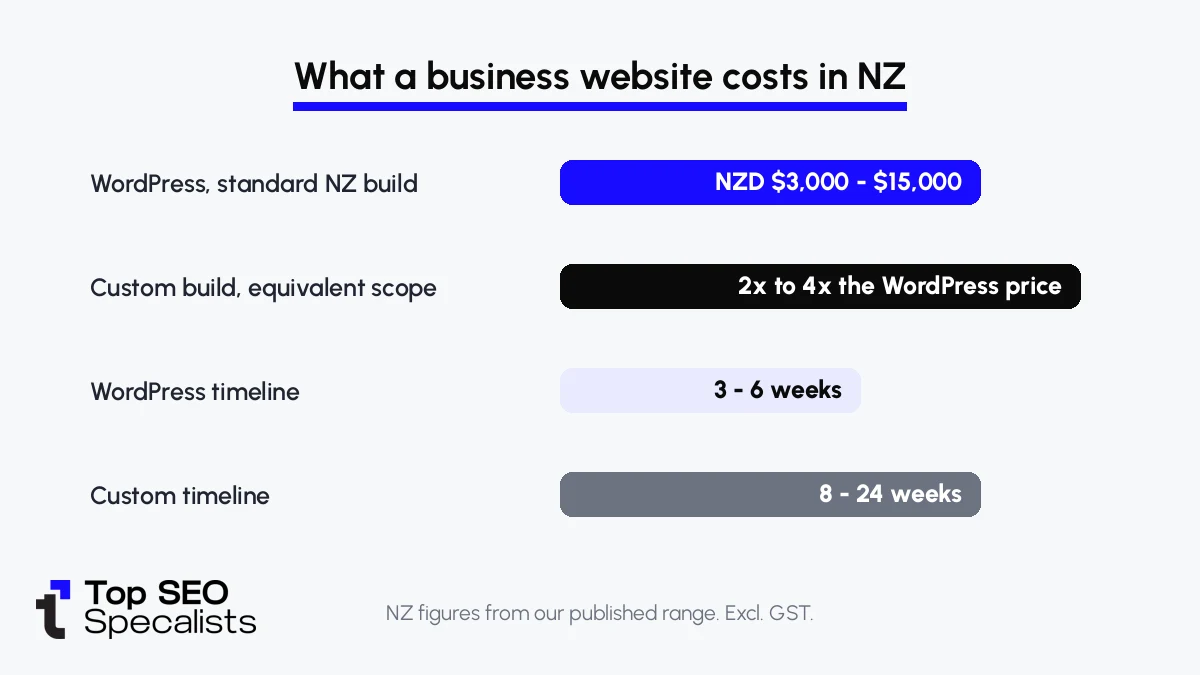
NZ build costs and timelines: WordPress vs custom, from our published range.
What does each option cost in New Zealand?
An honest note first: verified NZ-specific build cost data is thin beyond our own published figures, so we will anchor on those and attribute international benchmarks as directional. All figures exclude GST.
Our published range: professional NZ business websites typically cost NZD $3,000 to $15,000 depending on complexity, platform, and custom functionality, with standard WordPress builds taking 3 to 6 weeks. We quote fixed prices after discovery, not vague hourly estimates.
International benchmarks for context: US agencies put a standard WordPress business site at roughly USD $3,000 to $15,000 and a comparable custom build at two to four times that (Boolean Inc., Integrity Marketing, 2026). One UK agency models five-year total cost of ownership at £15,000 to £30,000 for WordPress against £60,000 to £150,000+ for custom (ProfileTree 2026).
The number that matters more than the build price is the three-year cost. WordPress starts cheaper but carries ongoing costs: premium plugin renewals, updates, security, and fixes. Custom starts expensive but has fewer moving parts to maintain. Ask every developer for a three-year estimate, not just the build price. It gives you the only fair comparison.
And the number nobody quotes: the cost of choosing wrong. A template site that cannot do what your business needs will be rebuilt within two years. A custom build for a ten-page brochure site is money spent on capability you will never use. The platform decision is cheap to get right and expensive to get wrong.
Speed, SEO, and security: the three anxieties, answered honestly
“Will it be fast?”
Speed depends on build quality more than platform. The most-shared test of 2026, by Australian developer Rod Fernandez, built the same page three ways and measured mobile Lighthouse scores: Astro 94, custom WordPress theme 92, WordPress with Elementor 76. His conclusion: it was not WordPress that cost the speed, it was the page builder. A well-built WordPress site routinely scores 90+. Google’s own research found 53% of mobile visitors leave when a page takes more than three seconds to load, so this is not vanity, it is revenue.
“Will it rank?”
Both can rank well. WordPress makes basic SEO easy with plugins for titles, descriptions, and sitemaps. A custom site gives you full control over structure, URLs, and speed. What decides rankings is helpful content and a technically clean site, not the platform’s name. A well-built WordPress site will beat a badly built custom one every time. Our SEO services start from that exact principle: the platform is a tool, the content and technical care are the strategy.
“Will it be secure?”
WordPress core is patched fast and has a dedicated security team. Breaches almost always trace to outdated plugins, weak passwords, or cheap shared hosting, not the core. A custom site has a smaller attack surface with no plugin ecosystem to patch, but it is only as safe as the developers who write it. Either way, the basics decide: updates, backups, strong logins, HTTPS.
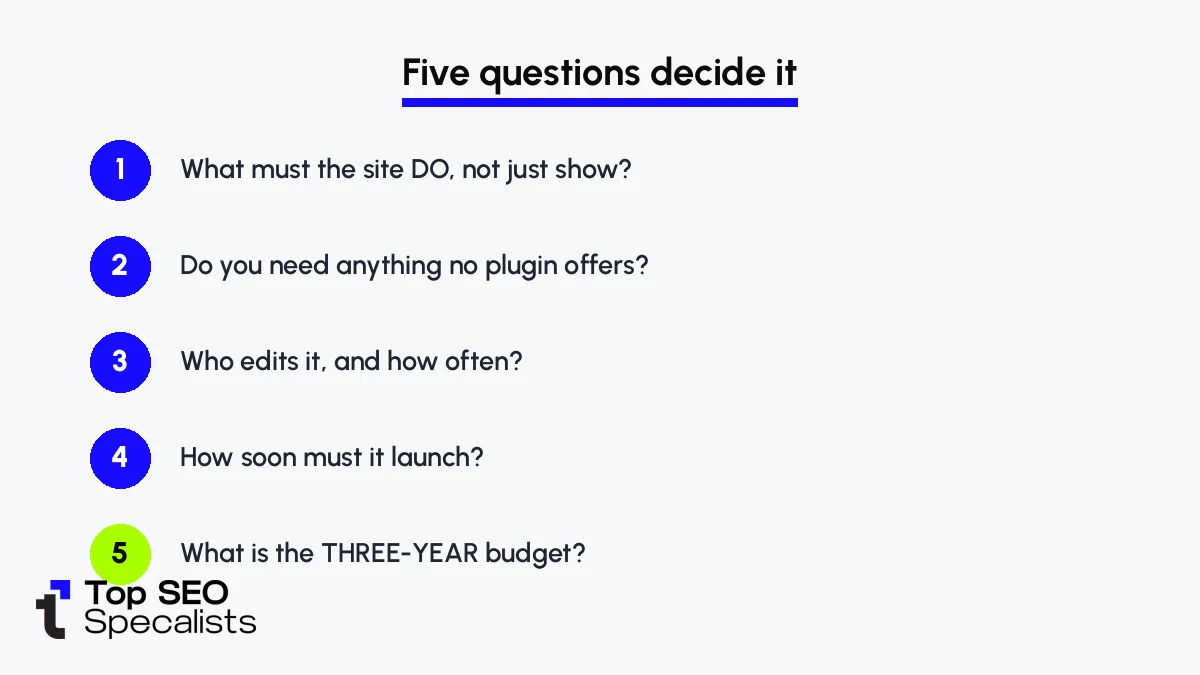
Five questions. Answer them honestly and the platform picks itself.
How to decide: the five-question test
Forget the feature lists. Answer these five questions and the decision makes itself:
✓ What must the website do on day one, and a year from now? List the jobs, not the pages. If the jobs are “explain, publish, capture enquiries”, that is WordPress. If they are “log in, process, integrate, transact”, that is custom.
✓ Do you need anything no plugin offers? Check first. Booking systems, membership portals, and complex forms often have mature WordPress plugins at a few hundred dollars a year. Do not pay $20,000 to rebuild what already exists.
✓ Who edits it, and how often? Daily content updates by non-technical staff point hard at WordPress. Occasional updates by one person can work on either.
✓ How soon must it launch? A hard deadline inside two months rules out most custom builds.
✓ What is the three-year budget, including upkeep? Not the build price. The build plus three years of hosting, maintenance, and changes.
If your answers point to standard needs, a short timeline, and a modest budget, WordPress is probably enough, and anyone telling you otherwise is selling. If they point to special features, system connections, and growth, take a serious look at custom, and anyone telling you WordPress does it all is selling too. For local businesses, our local SEO service covers the Google Business Profile work that turns “near me” searches into calls whatever platform you choose.
Frequently asked questions
Not inherently. Custom is better when your requirements genuinely exceed what WordPress can provide: web applications, complex user accounts, real-time features, or deeply custom business logic. WordPress is usually the better choice for content-driven business websites because it is cheaper, faster to launch, and easier for your team to edit.
Professional NZ business websites typically range from NZD $3,000 to $15,000 depending on complexity, platform, and custom functionality (our published figures, excl. GST). International benchmarks put custom builds at two to four times the WordPress equivalent. Always ask for a three-year cost estimate, not just the build price.
Both can rank equally well. WordPress makes basic SEO setup easy through plugins, while a custom site gives you full control over structure and speed. Rankings are decided by helpful content and a technically clean site, not the platform name.
Yes, when maintained. WordPress core receives regular security updates. Most breaches come from outdated plugins, abandoned themes, weak passwords, or poor hosting. A maintained WordPress site with trusted plugins and strong authentication is secure for most business use cases.
A standard WordPress business site typically takes 3 to 6 weeks from approved design to launch. A custom-built website usually takes 8 to 24 weeks depending on scope, because everything is planned, designed, coded, and tested from scratch.
Yes, and many businesses do exactly that: start on WordPress to prove the idea, then build custom when revenue justifies it. Plan the move carefully, keep your URLs or set up proper redirects, and protect your search rankings during migration.
For structural changes, yes. Most custom builds include an admin panel for content edits, but anything beyond content goes through the developer who built it. That dependence is the real ongoing cost of custom, so good documentation and a handover package matter more than the hourly rate.
A custom WordPress theme is designed and coded for your business but still runs on WordPress, so your team keeps the familiar editor. A custom website has no WordPress at all: it is purpose-built software. Many “custom” quotes are actually template WordPress sites, so always ask which of the three you are being offered.
What to do next
Run the five-question test above before you talk to any developer, and run the three-way check on every quote: template WordPress, custom WordPress theme, or fully custom-built site. The platform decision is cheap to get right and expensive to get wrong.
If your answers point to WordPress, our web development service builds custom WordPress websites that are fast, secure, and easy to manage, with SEO foundations built in from day one. If your site needs to do complex work that WordPress was never designed for, we also build custom web solutions scoped and quoted transparently upfront. And if you already have a website and suspect the platform is not the problem, start with a free website health check: we will show you exactly what is slowing you down and what to fix first. Get a free audit.
Building or rebuilding? Start with the health check, not the quote.
We will show you what your current site is doing wrong, whether WordPress or custom fits your brief, and what it should cost, before you commit to anything.
Keep reading
Content earns the traffic; the funnel decides the rest.
Every page needs the right words behind it.
Fast, SEO-ready WordPress and custom builds.