
Paid Search vs SEO: Which Should a New Zealand Business Choose in 2026?
2 November 2026 · By Top SEO Specialists
Choose paid search when you need leads within weeks and know what a customer is worth. Choose SEO when you can wait three to six months and want leads that keep coming without paying per click. Most New Zealand businesses end up running both: paid search for speed and testing, SEO for the long run, with the budget shifting toward SEO as organic rankings start compounding.
Key Takeaways
✓ Paid search buys visibility by the click. SEO earns it. One rents attention, the other builds an asset.
✓ In New Zealand, average Google Ads CPC sits around NZ$3.24 (Web Antler 2026 NZ benchmarks), but competitive industries pay NZ$5 to NZ$15+ per click (Bump Digital 2026).
✓ Effective NZ SEO retainers run NZD $1,500 to $5,000 per month; our plans start at $1,000 per month.
✓ Google states plainly that ad spend has no effect on organic rankings. The systems are separate.
✓ The decision comes down to three numbers: what a customer is worth, how fast you need leads, and what you can spend.
✓ AI Overviews and AI answers cite organic pages. They never cite ads.
What is the difference between paid search and SEO?
Paid search is advertising on Google. You bid on keywords, your ad appears with a “Sponsored” label above or below the organic results, and you pay every time someone clicks. In New Zealand that almost always means Google Ads. Pause the campaign and the visibility disappears the same day.
SEO, search engine optimisation, is the work of earning a place in the unpaid results: technical fixes, content that answers real questions, local signals like your Google Business Profile, and links from other sites. You pay for the work, not for each visitor. Rankings take months to build, but they keep sending traffic after the work is done.
There is also a third spot on the results page that sits between the two: the map listings, driven by your Google Business Profile. Appearing there costs nothing, which is why our guide to Google Maps SEO calls the profile the free foundation every local business should fix before spending on either channel.
Paid search vs SEO: the head-to-head comparison
The table tells you what each channel is. The sections after it tell you what each one costs in New Zealand, because the NZ numbers change the decision.
| Paid search | SEO | |
|---|---|---|
| Speed to first results | Hours to days | 3 to 6 months, longer in competitive markets |
| How you pay | Per click, plus management | For the work (monthly retainer or project) |
| When you stop paying | Traffic stops immediately | Traffic fades slowly; rankings persist |
| Cost per lead over time | Stays level or rises (CPC inflation) | Tends to fall as rankings compound |
| Control | Total: keywords, budget, geography, timing | Indirect: Google decides rankings |
| Searcher trust | Lower: most searchers know it is an ad | Higher: organic results carry credibility |
| AI search in 2026 | Ads are never cited by AI answers | Strong pages get cited by AI Overviews |
| Best for | Launches, urgent leads, testing, seasonal offers | Long-term growth, lower lifetime cost per lead |
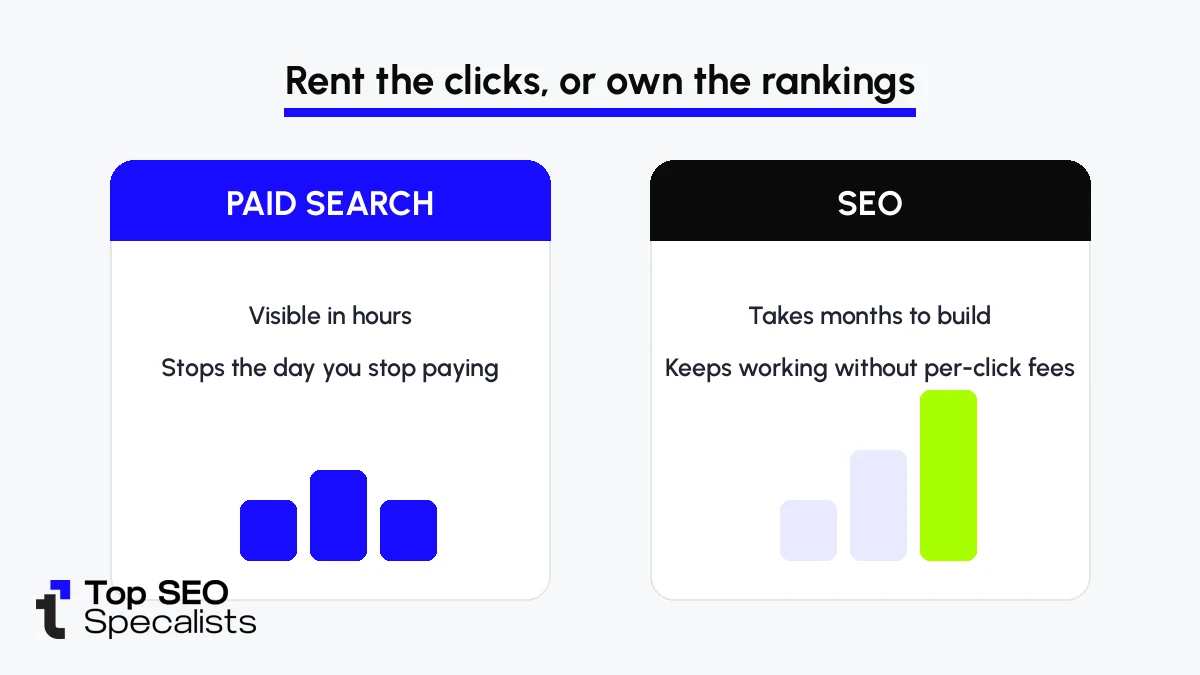
Rent the clicks, or own the rankings.
How much does paid search cost in New Zealand?
New Zealand is cheaper than the US for clicks but not cheap. Web Antler’s 2026 NZ Google Ads benchmarks put the average cost per click at NZ$3.24, against a global average of $5.26, with NZ click-through rates actually beating the global figure (9.12% vs 6.66%). Averages hide the spread that matters to you, though.
Bump Digital’s 2026 NZ guide breaks it down by industry: competitive industries like legal, finance, and insurance pay NZ$5 to NZ$15+ per click; trades and services pay NZ$3 to NZ$8; retail and ecommerce pay NZ$0.50 to NZ$3; niche products sit between NZ$0.30 and NZ$2.
Turn those clicks into customers and the maths gets honest fast. Take a mid-range trade keyword at NZ$5 a click. At a 5% click-to-lead rate you pay NZ$100 per lead. If one in four leads becomes a customer, each new customer costs NZ$400 in ad spend alone. At NZ$10 a click in a competitive category, that same customer costs NZ$800. Add management on top, and Bump Digital’s guidance starts to make sense: most New Zealand businesses should budget at least NZ$30 to NZ$50 per day, NZ$900 to NZ$1,500 per month, before expecting meaningful results.
All figures here exclude GST, and every one of them swings with your industry, your city, and how well your landing page converts. A slow page with a weak offer pays more per click for worse results, because Google’s Quality Score rewards relevance and speed.
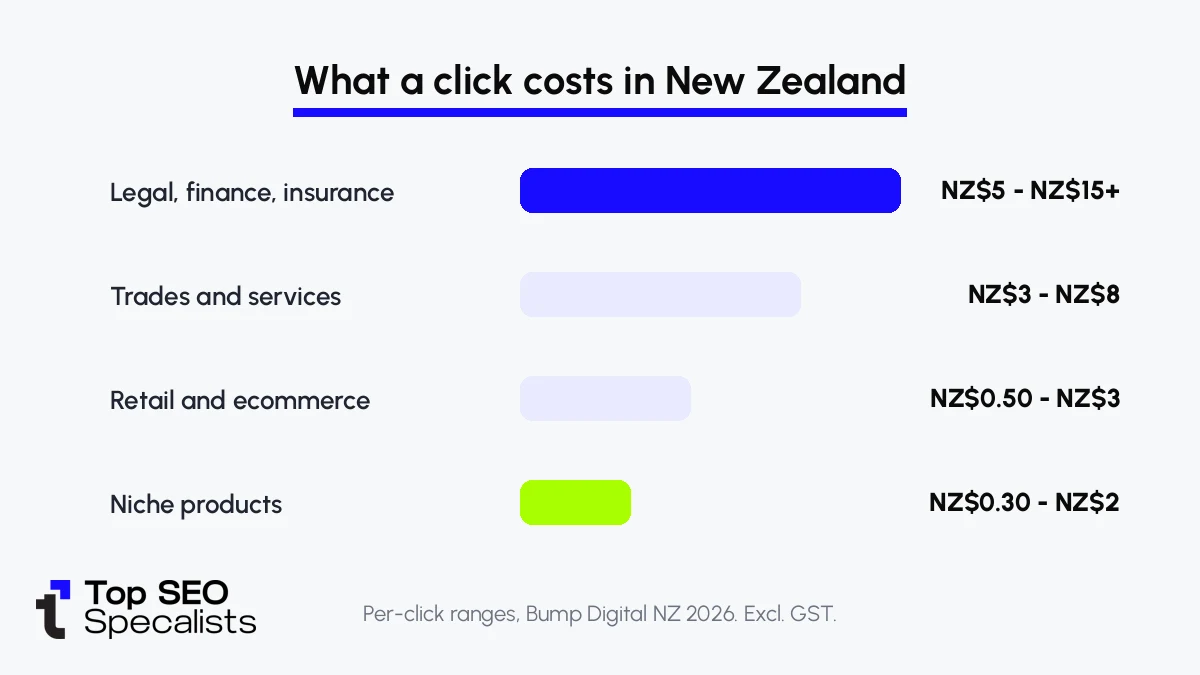
What a click costs in New Zealand, by industry (Bump Digital NZ 2026).
How much does SEO cost in New Zealand?
Our own SEO services page publishes the honest range: effective SEO in New Zealand typically costs between NZD $1,500 and $5,000 per month depending on how competitive your market is, and our published plans start at $1,000 per month. That buys the work: technical audits and fixes, keyword and intent research, content, local signals, link building, and reporting in plain language.
The price curve is the mirror image of paid search. Months one and two produce little visible return while the foundation goes in. Meaningful movement usually shows around months three to six, and the crossover point where SEO becomes the cheaper source of leads typically lands around months six to nine. After that, the cost per lead keeps falling while ad costs keep rising. A page that ranks well can send you customers for years on maintenance alone.
The honest cost of SEO is time and consistency. If your site is a technical mess or your pages are thin, you will wait months and conclude SEO does not work. The setup is what works. That is also why the cheapest quote is rarely the cheapest outcome: a few hundred dollars a month buys almost nothing, or buys shortcuts that end in a penalty.
When is paid search the better choice?
Paid search wins when speed or certainty matters more than efficiency. If this sounds like your situation, our paid marketing service runs Google Ads with tight targeting, proper conversion tracking, and landing pages built to convert.
✓ You need leads within weeks. A new business, a slow season, a new service launch. SEO’s timeline does not solve this quarter’s problem.
✓ You are testing. Two weeks of ads against a keyword tells you whether the traffic converts before you spend six months building SEO content around it.
✓ The search has urgent intent. Emergency plumbers, locksmiths, same-day services. People click the first credible option.
✓ Competitors own the organic results. If established rivals have years of authority, outranking them may take longer than you can wait. Ads bypass that gap.
✓ The offer is seasonal or time-limited. A flash sale needs instant visibility. SEO is structurally unsuited to short-lived campaigns.
Two warnings come with it. First, ads are not set and forget: keyword work, negative-keyword pruning, ad copy testing, and landing page tweaks are ongoing, and broad-match keywords with vague geography will spend your money on people who were never going to buy. Second, know your numbers before you start. If you cannot state what a customer is worth, you cannot set a cost-per-lead ceiling, and you are flying blind.
When is SEO the better choice?
SEO wins when patience is affordable and trust decides the sale:
✓ Your budget is limited but your timeline is long. SEO costs are front-loaded, then the per-click charge disappears. A page that ranks can earn enquiries for years.
✓ Clicks are expensive in your category. At NZ$10+ a click, ads eat the margin. SEO sidesteps the auction entirely.
✓ Customers research before buying. Legal services, healthcare, renovations, B2B. People read several pages first, and they trust organic results more than ads.
✓ You are a local service business. For plumbers, salons, accountants, and dentists, local SEO plus a complete Google Business Profile wins the “near me” searches. Our local SEO service covers exactly this ground.
✓ You want to be cited, not just ranked. Google’s AI Overviews and AI Mode draw answers from authoritative pages, the same pages that rank organically. Ads are never cited. In 2026, every strong page you publish is also an AI-answer asset.
One caveat, stated plainly: SEO does not work on a broken site. If your pages take over four seconds to load on mobile or you have no pages for your core services, fix that first. Paying a monthly retainer on top of a weak site is the most common way small budgets get wasted.
Do Google Ads improve your SEO rankings?
No. This is the most persistent myth in the comparison, so here is what Google itself says. Google’s Search Central page “Do you need an SEO?”, updated 5 June 2026, states: “Advertising with Google won’t have any effect on your site’s presence in our search results.” It adds: “Google never accepts money to include or rank sites in our search results.” Google Ads Help says the same from the other side: “Google’s search results are independent of Google’s advertising programs.” And for local, Google’s Business Profile help states there is no way to request or pay for a better local ranking.
The ad auction and the organic ranking systems are separate systems with no connection between them. If an agency promises rankings in exchange for ad spend, treat that as a warning sign, not a strategy.
What paid search genuinely gives your SEO is information, not rankings. An active Ads account shows you, in real numbers, which search terms and offers actually convert. That tells you exactly which keywords deserve SEO investment instead of guessing for six months. The benefit is better decisions, never a ranking boost.
How to use both without wasting money
The businesses that get the most from search treat the two channels as a relay, not a rivalry:
✓ Fix the foundation first. A fast site, a complete Google Business Profile, and proper service pages. This is the landing page for every channel you will ever run, and it lowers your cost per click if you advertise later. A good page serves both channels; a bad page wastes both.
✓ Run paid search on your highest-intent terms while SEO builds. The services that make you money, with conversion tracking and a landing page built to convert.
✓ Feed the ads data into SEO. Your campaigns reveal which keywords convert. Build service pages and content around those proven terms first.
✓ Shift budget toward SEO as organic takes hold. Do not switch ads off the day you rank; enquiries can dip before organic fully absorbs the demand. Taper gradually and watch total enquiries across both channels, not clicks on one.
✓ Keep a small ad budget permanently for testing new offers, seasonal pushes, and competitive terms you do not rank for yet.
Handled this way, paid search funds the early days and hands the baton to SEO, which carries the growth forward at a lower cost.
The three-number decision framework
Forget “ads for speed, SEO for the long term.” That advice is useless when you have one budget and must fund one channel first. Work out three numbers instead:
1. What is a customer worth?
Take the profit on an average customer, not revenue. If a new customer is worth less than about NZ$500 in profit, paid search gets difficult fast at NZ$3 to NZ$8 clicks. If a customer is worth NZ$1,000 or more, ads have room to breathe.
2. How fast do you need leads?
Inside 90 days: paid search, because SEO will still be climbing. Six months or more of runway: start SEO now, because the clock starts when the work does, and every month of delay is a month of compounding lost.
3. What can you spend every month?
Under NZ$900 a month total, paid search starves; put it into SEO and your Google Business Profile. At NZ$1,500 a month or more with a customer value above NZ$1,000, paid search becomes viable alongside SEO.
Two worked examples. A Hamilton electrician: average job profit NZ$450, needs work next month, budget NZ$1,200. Customer value under NZ$500 and leads needed fast points to paid search, but NZ$1,200 barely clears the minimum viable ad budget, so the honest answer is a tight, narrowly targeted ads campaign on emergency and high-intent terms only, plus the free GBP work in parallel. An Auckland law firm: average client profit NZ$4,000, steady pipeline, budget NZ$4,000. Customer value supports ads at NZ$10+ clicks, and the budget supports both: ads for immediate high-intent terms, SEO building underneath to escape the auction over time.
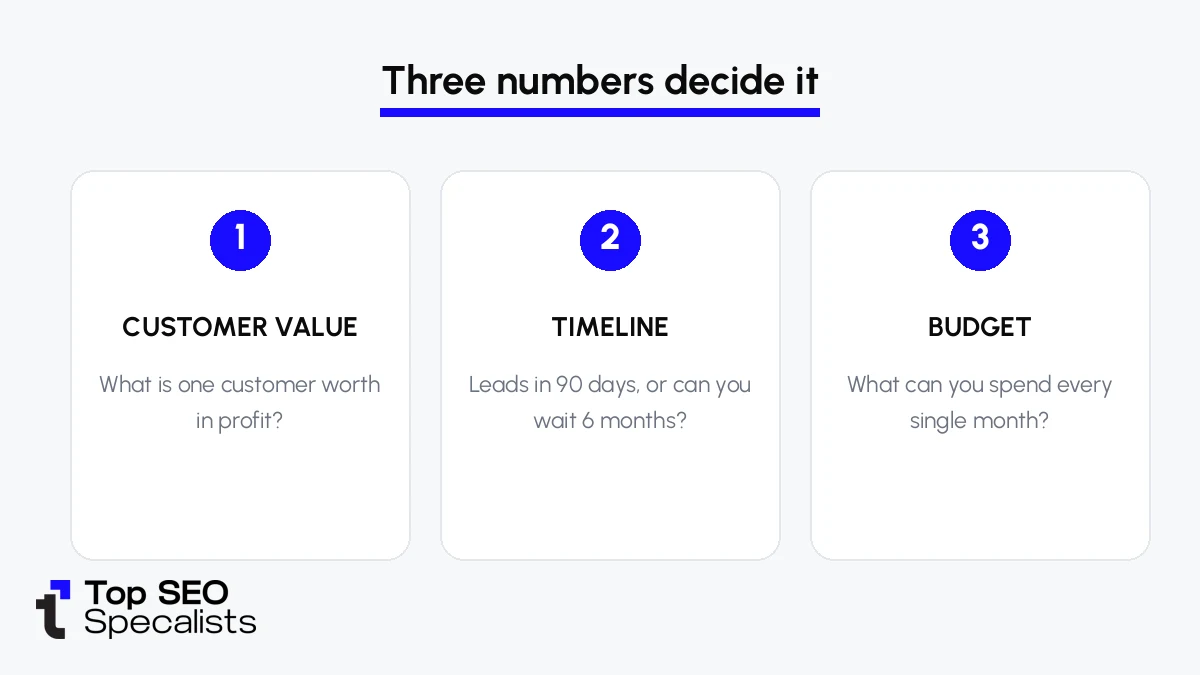
Three numbers decide it: customer value, timeline, budget.
Frequently asked questions
What to do next
If you are weighing this decision for your own business, run your three numbers before you spend anything: customer value, timeline, budget. Then pick the channel that fits this quarter’s problem, not the channel you have decided to believe in.
If the numbers point to paid search, our paid marketing service runs Google Ads with tight targeting, proper conversion tracking, and landing pages built to convert. If they point to SEO, our SEO services start with a technical audit and published pricing, and our local SEO service covers the Google Business Profile and map-pack work. Either way, start with the free foundation: our guide to Google Maps SEO walks through the profile setup step by step.
Or skip the guesswork and get the audit first: a free, no-obligation look at where you stand, what is broken, and which channel earns its keep first for your business. Get a free audit.
Still deciding? Start with the audit, not the guesswork.
We will show you where you stand, what each channel would cost for your business, and which one earns its keep first.
Keep reading
The free foundation to fix before spending on either channel.
How to vet whoever runs your SEO.
Google Ads run with tight targeting and proper tracking.